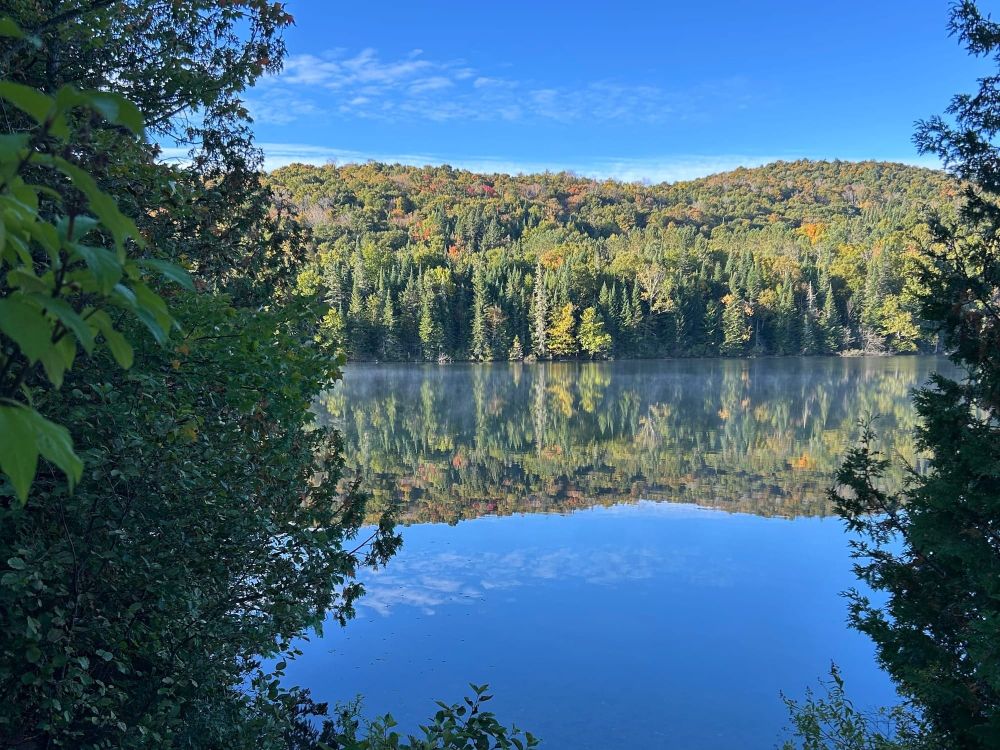
Here in the northern hemisphere, the days have begun their long surrender to darkness. The trees are preparing to let go, and starting to put on their annual show. We go apple picking, we take school photos to mark the kid at this age before another year of childhood is gone, we start bringing things inside: food, firewood, the potted plants on the porch, blankets, seeds, stories.
For a brief moment on the turning Wheel, the Sun crosses the celestial equator and the northern and southern hemispheres receive roughly equal illumination. It's the Equinox. We take a beat. For hundreds of thousands of years humans have noticed this breath, this balance... and how tenuous it is.
In Autumn, on the second harvest, on the holiday (or Sabbat) which marks the Equinox, all those who dance with the sacred and unknown, who feel the unseen energies of the universe, recognize a moment when the shadow world steps closer.
We feel into how quickly the Summer seems to fade, and how much we'll need - emotionally, spiritually, materially - to survive another Winter in the world.
The autumn equinox falls somewhere between September 21 and 24 each year, because Earth takes about 365.24 days to orbit the Sun, while our calendar counts 365 days (with leap years added to keep things aligned). The precise moment when the Sun crosses the celestial equator moves. Leaps. Dances.
The calendar itself is a cultural technology. The Gregorian calendar is a solar calendar, refined in Catholic Europe in the sixteenth century and later adopted by Britain and its colonies. It became the dominant civil calendar through centuries of European political, commercial, and colonial power. Other cultures organize time differently, including lunar and lunisolar calendars that track the Moon and, in the case of lunisolar systems, periodically adjust to keep lunar months aligned with the solar year. The dates we use to walk with the seasons aren't “natural” facts. They're part of a human story, tangled up with domination and erasure.
For many modern witches, this Sabbat is called Mabon.
But there’s history in the name too, of course. All names are bits of archeology.
Was Mabon actually an ancient Celtic festival?
Nope. Mabon is a figure from medieval Welsh mythology. Mabon ap Modron appears in Culhwch and Olwen, one of the medieval Welsh tales associated with the Arthurian tradition. His name is related to the older Celtic divine name Maponos, generally understood as “Great Son,” while Modron is connected linguistically with Matrona, “Great Mother.”
In the story, Mabon is taken from his mother when he is only three nights old. No one knows where he's gone. Eventually, Arthur and his companions discover that he has been imprisoned at Caerloyw, and he is rescued with the help of a chain of ancient animals, ending with the Salmon of Llyn Llyw, who knows where Mabon is hidden.
It's a story about disappearance, searching, captivity, recovery.
And it's a story about interspecies kinship and the possibility of return.
But there's no surviving Welsh evidence that the ancient Welsh celebrated an autumn equinox festival called Mabon.
The name came into modern Pagan use in the early 1970s, when American Pagan ritualist Aidan Kelly was constructing a Pagan calendar and wanted names for the solar festivals. In 1974, he chose Mabon for the autumn equinox, drawing on the Welsh mythological figure. The name circulated through Green Egg and later Pagan writing, eventually becoming part of the modern Wheel of the Year.
The equinox is ancient.
Mabon ap Modron is ancient.
Mabon as the name of the autumn equinox is modern and made up.
We don't need to pretend otherwise.
In fact, we like knowing that our traditions are alive, it helps us shake off the cloying weight of dogma.
We're craft people, we're weaving and weeding and choosing all the time.
A witch's calendar isn't a museum exhibit. It's a living technology.
Before Mabon, there was the harvest
Long before anyone called this Sabbat Mabon, people everywhere were paying attention to the changing light, the ripening fields and the approach of winter.
Harvest celebrations are wildly widespread. They don't all happen on the exact astronomical equinox, and they don't all mean the same thing, but again and again we find humans marking the transition from abundance toward scarcity with food, offerings, gratitude, gathering and ritual.
In ancient Greece, autumn brought Thesmophoria, a women's festival dedicated to Demeter. It was a women's festival, a festival where they left the men and the children and camped together, and lay on the ground together, listening in the Fall. It's associated with the agricultural cycle and the coming sowing season, and included fasting, descent and return imagery, secret rites and ceremonies connected with fertility and the earth.
In Japan, the autumn equinox falls within Higan, a Buddhist observance that extends across the days around the equinox. Families visit ancestral graves, clean them and bring offerings. The word higan means “the other shore,” and Japanese tradition understands this period as a time when the world of the living and the world of the ancestors are especially close.
And in the Maya world, astronomical observation of the equinox was woven into monumental architecture. At Chichén Itzá, the movement of the setting Sun across the pyramid of Kukulkán produces the famous serpent-like pattern of light and shadow around the equinoxes. The exact interpretation of the phenomenon remains debated, but the architecture itself demonstrates the extraordinary attention paid to seasonal solar movements.
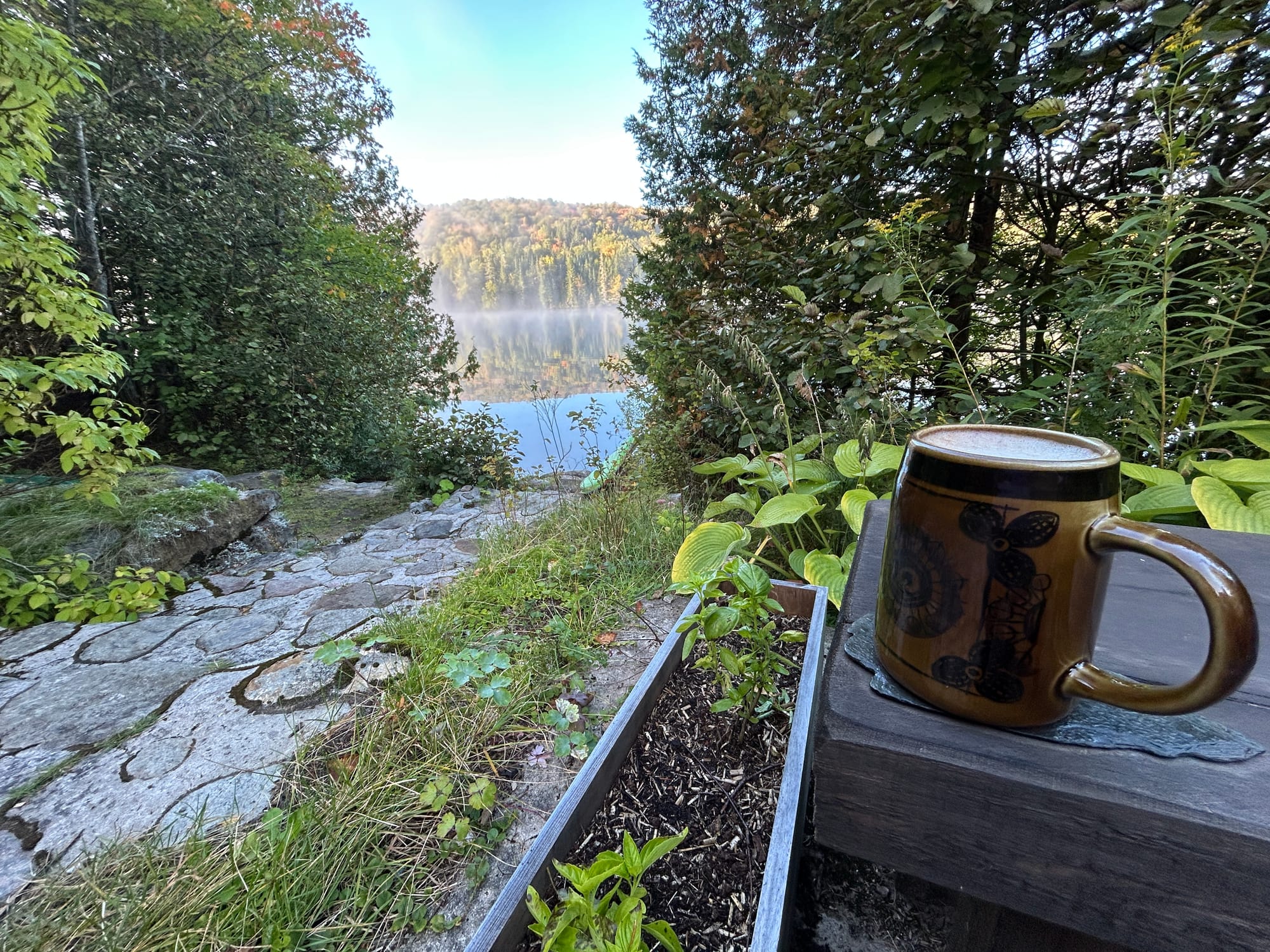
The equinox as a witch's time to give thanks
At Missing Witches, we like to think of the autumn equinox as our witch's Thanksgiving. Thanksgiving is a colonial holiday, built on the violation of Indigenous lives and cultures.
At Missing Witches we are dedicated to Reparations, so we leave the commercial celebration of Thanksgiving out of the picture, and instead we take this other moment, the balancing breath of the Equinox, to give thanks and to call in more justice.
This is the hinge between outwardness and inwardness.
The things we've made and gathered and learned are becoming the material from which the next year will be built.
What did you make?
What did you survive?
What became possible?
What became impossible?
What did you learn that you couldn't have learned any other way?
What do you want to carry into the dark?
What needs to weeded out?
And what can finally be compost?
What will you manifest, what is your MANIFESTO? What new world will you bring out of the journey into the underworld this year?
Why does the veil feel thinner now?
There's a popular idea in modern witchcraft that the veil between worlds thins at Samhain.
But the thinning begins as the leaves turn, and the night tips over.
At the equinox, the light itself is crossing a boundary.
The Sun moves across the celestial equator.
The season changes. The balance tips. The world begins its descent into the Underworld.
If spring equinox is a threshold into becoming, autumn equinox is a threshold into remembering.
We become more aware of what's passed. We notice the dead versions of ourselves. We notice the things that can't come with us.
We become more porous.
We are living at the edge of two seasons. And liminal places have always been good places for witches.
Witchcraft at the autumn equinox
So what do we actually do?
You don't need an elaborate altar or a perfect ritual. The oldest impulse here is simple: gather, give thanks, share, remember and prepare.
For Wiccans Mabon is the second of 3 Harvest Festivals, it is the apex of harvest and so it's time to ritualize gathering what's been tended and cultivated, and weeded out what we're not going to bring with us.
Make a harvest table
Bring the season inside.
Apples. Squash. Corn. Beans. Berries. Grapes. Root vegetables. Bread. Seeds. Herbs. Whatever is actually abundant where you live.
The point isn't to reproduce someone else's correspondence list.
It's to notice what your particular piece of Earth is giving you right now.
Make a meal.
Invite people.
Invite your ghosts, and tell their stories. Bring a plate to the crossroads and thank the gods and goddess of changes.
Give something back
Harvest has always carried an ethical question with it:
If I take, what do I give?
Leave an offering for the land. Feed birds. Save seeds.
Donate food.
Share what you've grown.
Bring groceries to someone who needs them. Bake a pie, bring a loaf of bread.
Give money to an organization doing work you believe in. Make reparations.
A harvest ritual can be materially useful: put some of your hard earned harvest onto the altar of what you believe in at this time of year and that will become one of the torches that light your way.
Perform a balance ritual
Light a candle in front of you, cast a circle of protection around you, and ask your contradictory selves to make themselves known. With your non-dominant hand write down what comes to you for one minute without raising your hand.
Then make two lists, or maybe it's just two words. What are the names of the two selves who contradict? Witch and Mother? Dancer and diver? Chronically ill and leader?
Stand between them. Open your arms and feel the weight of them in your hands.
Shift gently from foot to foot, looking out of your opposing eyes at the world of your opposing selves.
Watch the worlds flicker until they join, in you. You are the meeting point of the Venn diagram.
Blow out the candle and ask:
What would balance feel like now?
Not forever.
Now.
The equinox isn't static balance. It's the precise moment before the balance tips.
Do a release ritual
Write down what you're finished carrying.
A habit. A fear. A story about yourself.
An obligation that no longer belongs to you.
A relationship with an old version of yourself.
A grief you are ready to let change shape.
Sit with an apple fresh from this season and pour your thanks into the apple for whatever you're taking from this thing you are releasing. Eat that apple with gusto, let it's juice drip down your chin. Then bury the paper with it's seeds.
We release things because they mattered enough to change us, we eat them up with our sharp teeth. And then we get to let the new self grow.
Go outside at sunset
Watch the light disappear.
Pay attention to what's still green.
Look at the Moon if it's visible.
Notice the first cold.
Put your arms around a tree and tell it your secret name, and ask it for it's name in return.
Find one fallen leaf you love. Bury yourself in leaves. Make a flower crown from the last of the bright yellow golden rod. Be a child in the Fall.
Remember that the Earth doesn't experience autumn as a metaphor.
This is happening.
The light really is changing.
The leaves really are breaking down.
The soil really is receiving what falls.
You're part of it all.
The magic of beginning again
Autumn isn't a clean slate.
Autumn is messy. It's full of unfinished things.
It is the season of ripeness and rot, abundance and loss, beauty and decay.
We don't become new people.
We can become more deeply acquainted with the people we've already been becoming. We can greet our shadows and prepare to spend a season getting to know what that have to teach us about this turning of the Wheel.
Blessed Equinox, witches.
May you know what to harvest.
May you know what to release.
May you balance between all your selves and find the twisting path, the Witch's way through, that's only for you.
May you know what's worth carrying into the dark.