I'm going to Newport News
Just to see Aunt Caroline Dye
She's a fortune tellin' woman
Oh lord and she don't tell no lie
Hi Coven, it’s Amy, and if you know me, you know that in this house, music isn’t background noise, it’s not the soundtrack to life, it IS life. I often quote Kurt Vonnegut who said that music was the only proof he needed of the existence of God. My philosophy goes one step farther - music IS God.
So when someone like me hears legendary bluesman Howlin Wolf belt out a gravelly list of names he’s inviting to his Wang Dang Doodle, and that list includes a conjure woman, a hoodoo lady, we pay attention. When the name of a Witch (who, for the record, would never have called herself that word) shows up in dozens of songs, sung by bluesmen from the genesis of the blues itself, we know we’ve gotta dig a little deeper.
Aunt Caroline Dye, whose legend encircled her town of Newport Arkansas in a 400 mile diameter, had become famous for her hoodoo, rootwork, conjure, psychic abilities, to locate lost or stolen goods and predict the weather.
Aunt Caroline made mojo bags. She used regular playing cards to focus her concentration, she was born into slavery but died rich and famous, and became perhaps the most notable Hoodoo practitioner that Arkansas has ever known, her legacy preserved through the songified oral history of America in the Blues.
But before we stray too far from Howlin Wolf’s Wang Dang Doodle, it’s definitely worth mentioning, and yes, taking a long detour on these railroad tracks from Tennessee to Arkansas to mention that Ryan Coogler got the idea for his movie Sinners while listening to this song! And the evidence of the inspiration is everywhere in the film. The twins are named Smoke and Stack, Howlin Wolf’s most famous song is probably Smokestack Lightning. One of the defining figures of Mississippi/Delta blues, Howlin Wolf was born in Mississippi and spent part of his early musical life around Clarksdale, where Sinners is set.
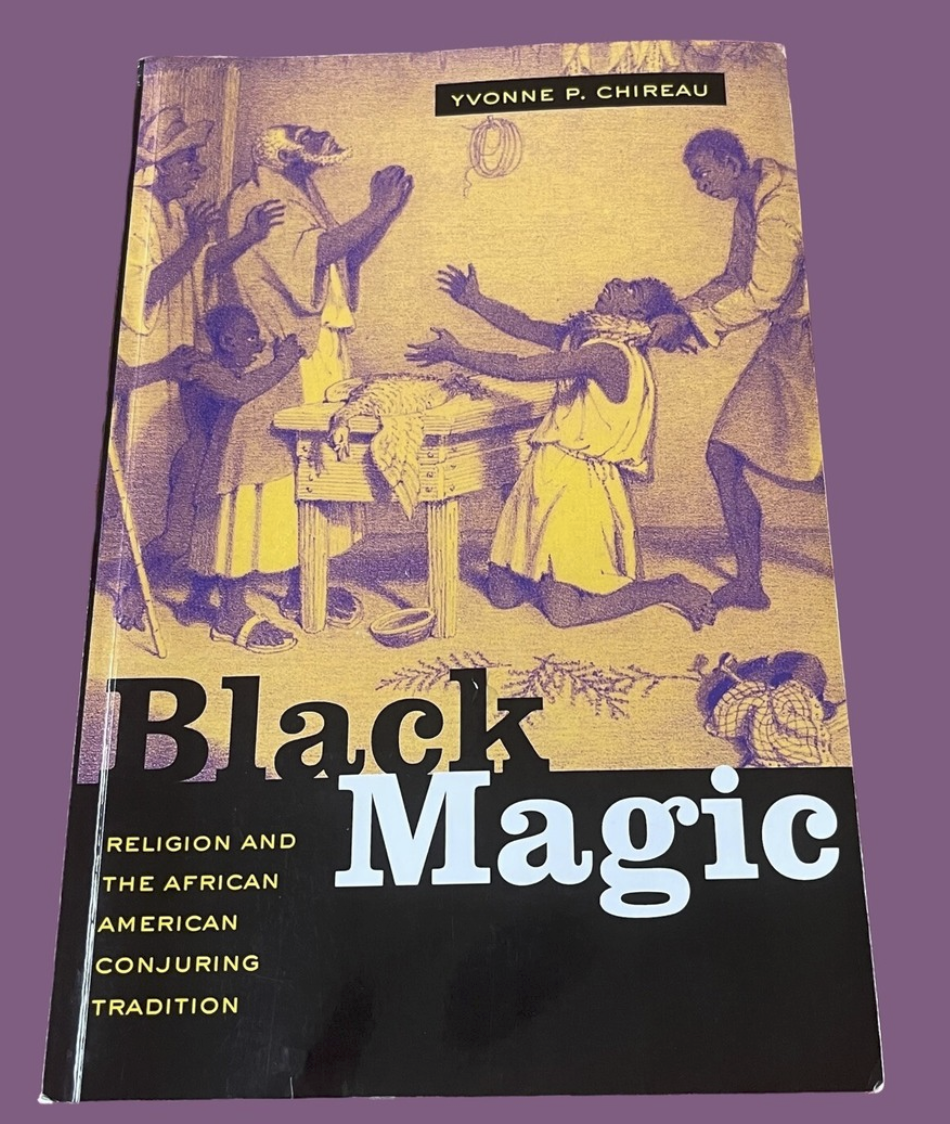
Professor Yvonne Chireau, who you may have heard on the Missing Witches podcast, was a consultant for Sinners. In her book Black Magic, she wrote “The blues were the first commercially produced music to explicitly embrace the culture from which conjuring traditions emerged” and she uses Aunt Caroline as an example when she writes: “Blues performers revered figures from the traditions of conjuring, divination and root working. Aunt Caroline Dye [...] was immortalized in a succession of popular recordings [...]”
Reviewing the film, Sheldon Pearce wrote: “In 'Sinners,' the blues is a portal between this world and the next.”
And I haven’t stopped thinking about one scene and quoting Annie since my first of many many viewings, ‘how you know I aint pray, and work every root my grandmother taught me, to keep you and that crazy brother of yours safe.’ Smoke says he doesn't believe in her Rootwork practice… people don’t believe in my magic, in our witchcraft, all of us, either, but we’re still here, aren’t we? And we Witches can’t count out the possibility that we have our spellwork to thank.
And of course the whole film, no spoilers but c’mon, if you haven’t seen Sinners yet, watch it today… just like our Aunt Caroline, Sinners draws together the stories of Hoodoo and The Blues, both portals between this world and the next. Wang Dang Doodle was originally written by Willie Dixon around 1930, possibly based on his own lived experience, going to see Aunt Caroline Dye.
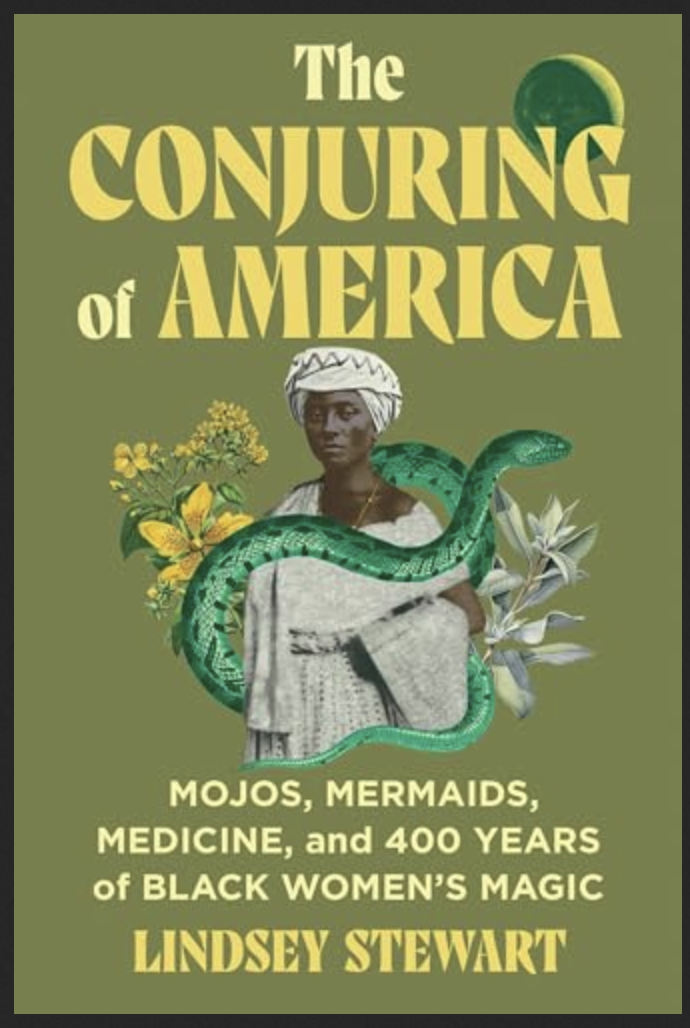
In The Conjuring of America: Mojos, Mermaids, Medicine and 400 Years Of Black Women’s Magic (by the way I’m loving this book, definitely pick it up if the subject interests you) Lindsey Stewart wrote:
"IF YOU WERE IN TROUBLE in the 1910s, you might take a trip on the "Carolyn Dye Special," a train line that would take you near the house of Aunt Caroline Dye in Newport News, Arkansas, a mere hundred miles from Memphis.
Once you deboarded the train, you might ask others at the station, "Do you know where Aunt Caroline Dye lives?" A little Black girl off to the side would overhear and flag your attention. She would offer to take you there for a quarter. As you followed the little girl along to the big house, with a small house to one side and a lot in the back where cows and chickens grazed, your heart might sink at the buggies and cars that lined the road.
The sheer volume of people milling about Aunt Caroline Dye's yard meant that your wait for a consulting session would be mighty long.
Perhaps the little girl would smile and point to the long table/s/ with white cloths a few paces away where you could get a good meal for just thirty-five cents as you wait-fried chicken, bisquits, buttermilk if you wanted it or sweet milk, all you could eat or drink. There was not much else to do as you waited your turn to visit with the woman who newspapers called the worst woman in the world.
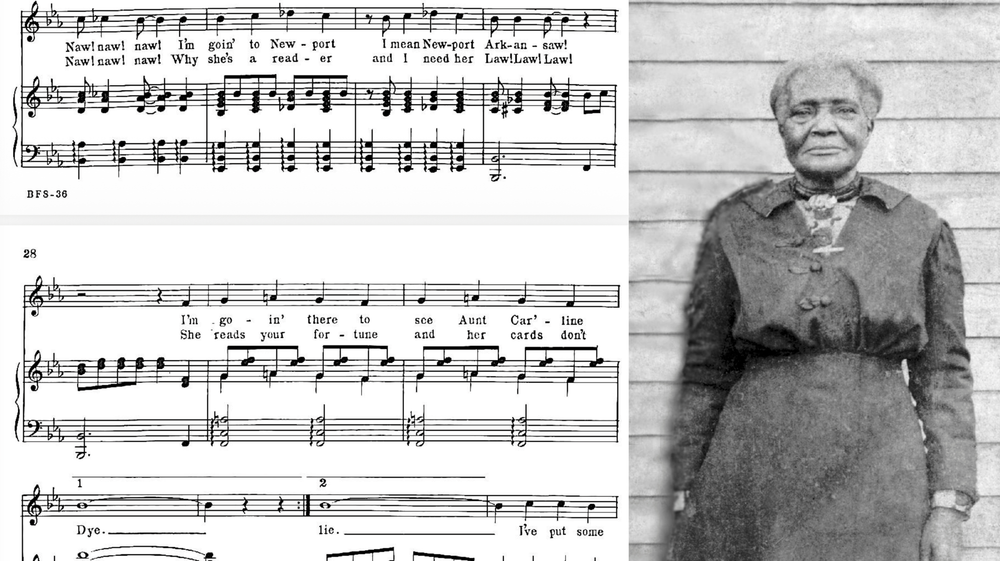
Aunt Caroline Dye was one of the most famous conjure women in the Mid-South during the twentieth century. She was born into slavery around 1843. Though she never charged for her services, people still gave her money for a job well done.
By the end of her life, she had acquired a tidy fortune amounting probably to $100,000 upon her death, about $1.5 million today. This she had done as a wealthy landowner land] rental property entrepreneur even though she was unable to read or write.”
And I gotta stop here for a moment to revisit Harriet Tubman who ALSO could not read or write, thanks to a history of enslavement that tried to force Harriet and Caroline away from education and from freedom. I’ll say again: so many people I know have convinced themselves that they aren’t smart enough or educated enough to be a powerful Witch, a powerful activist, a powerful human. Now imagine if Harriet Tubman had thought the same…
The Memphis Jug Band sang the Aunt Caroline Dye Blues:
[Verse 3]
Aunt Caroline Dyer, she told me
"Son, you don't have to live so rough" (Yes)
Aunt Caroline Dyer, she told me
"Son, you don't have to live so rough,"
"I'm goin' to fix you up a mojo
Oh lord, so you can strut your stuff"
(Go on and strut your stuff!)
And this is the relationship we see again and again, music is magic. It’s a place where we can put our suffering and turn it into something worth holding on to. A place where we can trade stories without words. Hoodoo and the blues grew from the same soil: the African American communities of the south, where West and Central African traditions, Christianity, folklore, work songs, spirituals, and lived experience intertwined with the musicians and mojo-makers’ deep need to wrench power from the hands that sought to oppress them.
Yvonne Chrieau wrote:
"The blues articulated black’s experience of alienation, victimization, and loss, and as such, like conjure, became existential appeals for control in an uncontrollable universe. Blues lyrics gave voice to suffering by describing both personal and collective afflictions.[...]while the blues most assuredly embodied mythologies of evil, they were also attentive to the ways of addressing the affliction by immediate practical means."
As cultural historian Albert Murray explains “[the Blues] affirm life and humanity itself in the very process of confronting failures and existential absurdities. The spirit of the blues moves in the opposite direction from self-pity and self-hatred.” And we feel this in all magic - we Witches confront existential absurdities and use our witchcraft to turn away from self-pity and self-hatred, toward empowerment. For black folks in america, Hoodoo suggests ways of acting on external forces, changing the practitioner's fate. The blues tells the story. Both give the work a voice, and together, they create a system for surviving a world that wants them to live rough.
Blues lyrics are filled with a Hoodoo vocabulary: mojo bags and hands, roots, conjure, spells, black cat bones, High John The Conquerer (I could do a whole episode about High John - and in fact I think I will - come back during our spring kinship season for that)... in blues we hear songs about crossroads, fortune tellers, and indeed the blues carried stories of hoodoo practitioners and magical practices into a wider cultural world. The Blues transformed Aunt Caroline Dye, a real Arkansas diviner, a real Witch who practiced real magic, into a figure of mythology. To the point where “I've got to go to see Aunt Ca'line Dye.” became shorthand for having troubles, or seeking the help of a conjure woman.
Aunt Caroline Dye’s mojo bags had a whole cultural history wrapped inside them with the roots. Lindsey Stewart wrote:
“IN THE 1910S AND 1920S, MOJOS BECAME A LIGHTNING ROD FOR RACIAL politics in America due to an important event that occurred overseas: the United States' invasion and occupation of Haiti, which lasted from 1915 to 1934. At the turn of the twentieth century, Haiti went through a period of political instability: A Haitian president was assassinated, and the people of Haiti took to the streets in violent protest of his murder.
In 1915, the United States sent in troops to "restore" order and democracy to Haiti. A large part of that restoration involved eliminating the presence of their Vodou prac-tices, which the US government took to be a source of social degeneracy and barbarity. Americans saw Haitian charms and amulets, their dolls stuck through with shiny pins, as evidence of their secret pacts with the devil.
The West has long feared the Vodou of the Haitians, for it was intimately linked to Black struggles for freedom. It was rumored that a Vodou ceremony incited the Haitian Revolution over a century earlier in1794.
[...]
For the United States, part of what it meant to gain control over Haiti was to suppress the Vodou practices of Haitians. So during the United States' occupation of Haiti, soldiers were sent with instructions to rid the island of these objects and religious practices. In memoirs and travel reports, these soldiers relayed stories that vilified Vodou practices to the American public: rituals that involved cannibalism of chil-dren; voodoo dolls that cursed unsuspecting neighbors; spells that turned people into zombies or the living dead. [...]
These manufactured images of savage Haitians gripped the American imagination. White Americans began to link the state of Blacks in Haiti with the state of Blacks in their own country. White Americans believed that if Blacks were left to govern themselves, like in Haiti, they would lapse into the "barbarity" of Vodou. In the minds of white Americans, inherent African savagery justified US occupation of Haiti, just as it justified the system of Jim Crow in their own country. The mojo of African Americans, to the broader American public, was a reminder of what happens when Blacks take control. Haitian zombies and voodoo dolls came to represent what white Americans feared would happen if Blacks were truly free-that e would turn around and enslave them.
Anything that threatened white supremacy, anything that represented Black freedom and independ-ence, was seen as evil by our oppressors. But this devaluation of our conjure by the broader American public did not deter us. Rather, as Zora Neale Hurston notes, we just went on in our conjure, unknowingly influencing American music and enjoying ourselves hugely while doing so, in spite of the derision from the outside. So while America was busy ridiculing conjure, African Americans were placing mojos at the heart of their blues.”
But as we see so often, what the whites perceive as a threat can have its tune changed when those whites figure out they can use it too - for money, for luck, for their own personal gain. Caroline Dye was allowed to continue her work, albeit often surrounded by bodyguards, because she helped the white man too.
AS LINDSEY STEWART also WROTE:
“Among African Americans, Aunt Caroline Dye was considered a powerful spiritual leader. It was said that African Americans held great reverence for her and considered her word las] law. Her spiritual leader-ship, in part, was granted because of the real problems she helped them face. Due to the herbal base of her conjure, she had incredible skills as a lay nurse. Due to her special knack at finding lost things, they turned to her to reunite families often forcibly separated during slavery. And due to her mojos, she gave African Americans the hope and strength they needed to endure and protest Jim Crow.
Even white men went to consult with her. It was said that men high up in business affairs laid great store by her alleged remarkable power to foretell occurrences, and that before making a financial move involving any considerable amount of capital they would first consult Aunt Caroline Dye.
Shuffling a deck of cards to help her focus, Aunt Caroline Dye would offer these men advice on their business affairs, much like a money manager on Wall Street. She was so successful that men from as far as Chicago and other cities of the north and east [came] for a "sitting" with the old woman in her Arkansas home.
During Jim Crow, any Black woman who possessed Aunt Caroline Dye's amount of wealth and authority would draw unwanted attention from neighboring whites in the com-munity. In 1909, newspapers report that Aunt Caroline Dye was visited by a deputation of citizens in an endeavor to ascertain whether a cowering wretch [Albert Turner] being guarded by a mob was the right man to hang, following an assault upon a young woman /Ber-tie Warren] of a distant town. Similar scenes occurred frequently across the South during Jim Crow: a Black man accused of assaulting a white woman as pretense for lynching. But there was a twist in this story. The deputies who appeared at Aunt Caroline's doorstep wanted her to use her conjure to confirm that Turner was indeed responsible for the crime.
Aunt Caroline was powerful, but even she was not in the position to outright refuse her services to law enforcement. Instead, she simply strung the white citizens along without naming who was responsible for the assault. At first, she told the deputies that Turner was not guilty, but that she could name the guilty party at a later date. So the deputies set a mass meeting where she could name the assailant in front of a mob of four hundred people. When the meeting came, she gave them much general information but did not specify who is guilty.”
You heard my interview with Treasure Shields Redmond earlier this week, but what you didn’t hear was me asking her if she had thoughts about her Hoodoo predecessor, Aunt Caroline.
"The way that Conjure and Black Spiritualism has operated is: in polite company, people are going to go to a physician and a preacher, but everybody knew that, if you had exhausted those options, that there was a third way - and Black Spiritualism and people like Aunt Caroline Dye were the third way. Which is why they were left alone. Which is why they weren't persecuted, because people of power and means waited until dusk and then came to see them, just like the people in their own community."
And I’m reminded of a quote from the great Silvia Federici, one that Risa and I repeat all the time: “…the revival of magical beliefs is possible today because it no longer represents a social threat.” Aunt Caroline was allowed to continue her practice because the White Law thought that it could benefit them too.
Aunt Caroline became aware of her abilities as a seer while still a young child. She could reportedly see things outside her line of vision that others could not. Among several early examples is a story that, during the Civil War, she foretold a visit by a member of the family, someone thought dead in the early years of the war.
One story-teller told an interviewer:
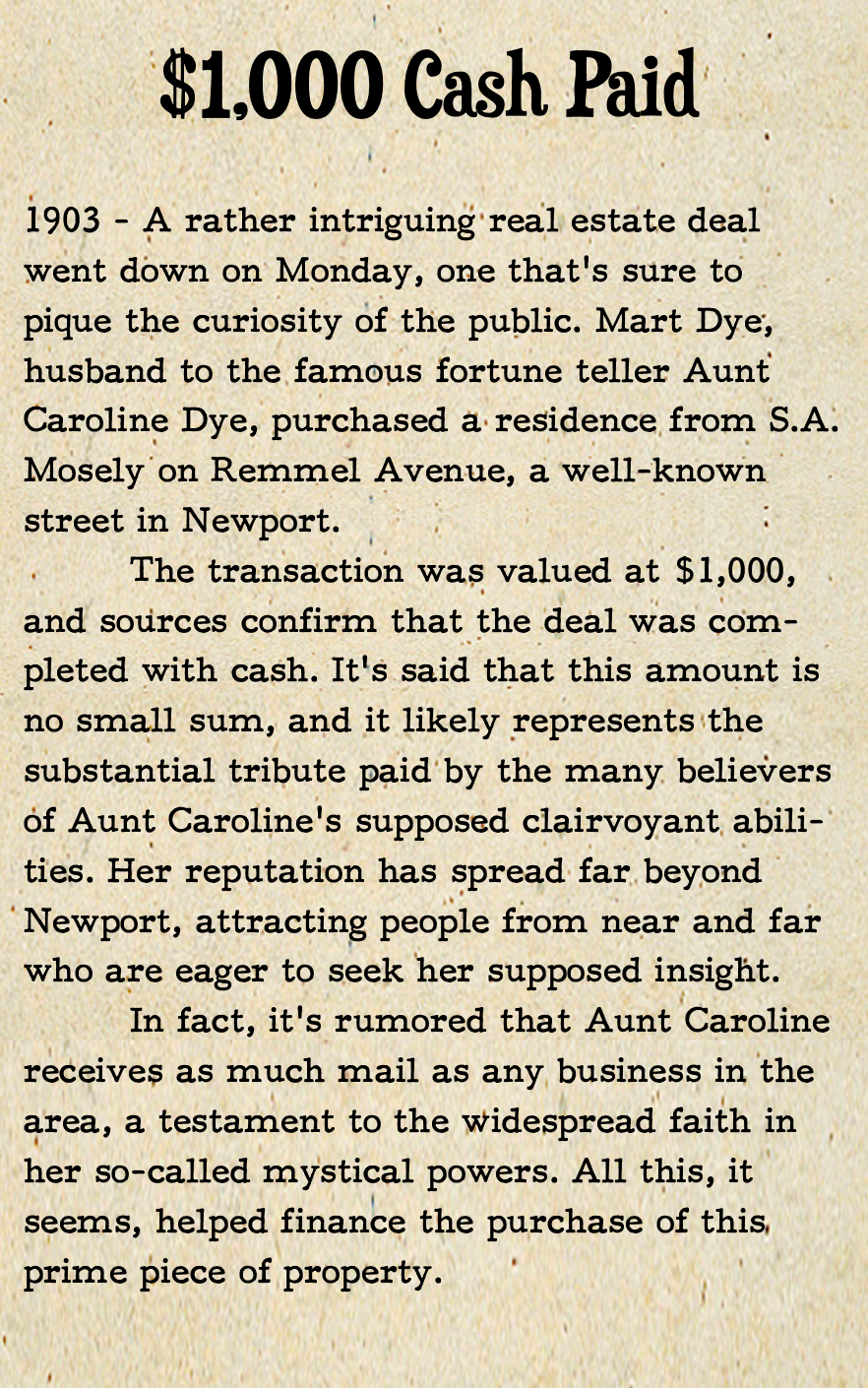
And while a lot of her fortune came from her work as a seer and Hoodoo lady, she and her husband also made some very shrewd business decisions, like the one written about in this newspaper article from 1903:
But what did her magic look like? Feel like? The stories abound.
John Quincy Wolf (no relation to Howlin Wolf hahah) wrote:
A Newport lawyer, Mr. Wesley Bengel, told me the following story about an experience of his father in 1901. One morning Mr. Bengel, Senior, found his barnyard gate unlatched and his mare and mule gone. Suspecting theft, he spread the news about town but got no clues. At his place of business a friend suggested that he see Aunt Caroline.
"I don't take any stock in that kind of thing," said Mr. Bengel.
"Well," said the friend, "you have to pass right by her house on your way home, and it won't take ten minutes. It won't cost you anything either, but of course you can hand her a dollar if you want to."
Two days after the stock was stolen, Mr. Bengel went to see Aunt Caroline. When he entered her house, she opened the door of her consultation room and said to him, "I know you don't believe in me, but set down anyhow and I'll see you in a minute." When she called him into her private room, she said, "You don't think I can tell you nothin', but you come here to ask me about some live stock."
"Yes," said Mr. Bengel, "I've lost a mare and a mule."
"Well, if you'd come here as soon as it happened, I could a helped you. Your stock was stolen, and if you'd a come earlier, maybe you could a found 'em. But now they're clean out of the country. There was two men on horses and I can't tell you their names, but you know 'em both. They came at night and took your stock and headed east. They went by Cow Lake. The water in the lake is low right now and the ground around it is mostly dry and cracked. But on the south side it's wet and soft. And if you'll go out to the south side you'll see the hoof prints of four horses, and if you know what kind of marks your mare and mule make you'll see them there. The men went on to the first house east of Cow Lake and spent the night there. The owner of the house wouldn't take pay from them the next morning, and they headed east, and are over in Poinsett County now. I can't tell you any more about them, but if you go ask the man on the other side of the lake where they spent the night, he'll tell you what I just told you.
"Now I'll tell you something else. You lost a saw and a hammer last week. You went down in the pasture to mend the fence, and a neighbor come along while you were working and you got to talking to him and laid your hammer and saw down in the tall grass. And after a while both of you went off to look at something and you forgot your hammer and saw. But if you go down to the fence you'll find them in the tall grass." 4
Since the hammer-and-saw story turned out exactly as Aunt Caroline had related, Mr. Bengel thought it would be worth the time to follow up her account of the live stock theft. So he rode a horse out to Cow Lake, where he recognized the prints of his mare and mule and went on to the house where the thieves had spent the night. He did not attempt to follow them further because the information he got was too indefinite, but he found the rest of Aunt Caroline's story accurate so far as he could check it.
Several stories are told about how Aunt Caroline first became aware of her powers. A man who worked on her farm and in her home for several years gives this account, but he says that it is hearsay and so far as he knows it did not come from Aunt Caroline. When she was about twenty, before she came to Newport, she took sick and died. A wooden coffin was made and her body was placed in it. But she awoke and climbed out of the box. Thereafter she found that she could read the past, present, and future.
According to another story, Aunt Caroline showed powers of prophecy when she was a child. Born into a family of slaves, she had the knack of making predictions that somehow came true and of making lucky guesses that attracted attention on the plantation. But no one thought much about her until Thanksgiving Day, 1865. The master of the plantation had a brother, Charley, who had been reported killed in the War in '61. On Thanksgiving morning, 1865, when the table was set for the big dinner at which the family would celebrate its reunion, Caroline, then about ten years old, told the women of the house hold that they hadn't set enough plates. They counted and the mistress assured Caroline that the number was correct. But the child remonstrated: "You ain' got a place for Mistah Charley." She was reminded that Uncle Charley had been killed four years ago. Yet she still maintained that "he's coming to dinner today."
The family had just started eating when they heard footsteps in the hall, and a very tired Uncle Charley walked into the room. He said that he had been severely wounded in '61, taken prisoner, and kept in a prison hospital until after Appomattox. He had written letters but they had evidently been destroyed at the prison or lost in transit. The family thought he might have been in the neighborhood for several days before Thanksgiving and that Caroline had learned of his arrival. But he assured them that he came straight from the prison and had spent the preceding night twenty-five miles away.”
“On one occasion, a man from the nearby town of Oil Trough, came to her with his daughter. She was in a terrible state of mind. She walked on all fours and would howl and scratch like a dog.
After examining her, Caroline went to work, making up a potion. Taking two small bags, she mixed what she called "Rattlesnake Dust" and "Adam and Eve Dust," placing the bags on the girl's shoulder and chest. The girl immediately started showing signs of coming back to her right mind.
"When you get home, "Caroline instructed the girl's father, "take a wash pan and mix turpentine with the water. Have her wash her hands and toss the water towards the east for nine days straight. She is to repeat the phrase 'Here am I. Take all my troubles away.' She will soon return to normal. She has an enemy, a lady named Lou. Lou put a 'crazy spell' on her and made her think that she was a dog. She will be okay now. You can take her home."
And while I hope there’s no such thing as a ‘crazy spell’ and hesitate to recommend magic for medical issues, I did wash my hands and tossed the water towards the east one day, repeating the phrase 'Here am I. Take all my troubles away' and I gotta say, it helped.
And the bluesmen kept singing:
W.C. Handy names her directly, in his 1923 song “Sundown Blues.”
For I’m going to Newport I mean Newport Arkansaw I’m going there to see Aunt Car’line Dye Why she’s a reader And I need her Law! Law! Law! She reads your fortune, and her cards don’t lie. I’ll put some ashes in my sweet Papa’s bed, So he can’t slip out, Hoodoo in his bread
In 1937, Johnny/Johnnie Temple named her again in his “Hoodoo Woman” song:
Well, I’m going to Newport, just to see Aunt Caroline Dye Well, I’m going to Newport, just to see Aunt Caroline Dye
She’s a fortune teller, hooo, Lord, she sure don’t tell no lie And she told my fortune, as I walked through her door
And she told my fortune, as I walked through her door Said, “I’m sorry for you, buddy, hooo, Lord, the woman don’t want you no more”
Her gravestone reads: Caroline Dye The Sunbeam of the World, so remember Witches, even if you have the blues, you can still be a sunbeam and a legend.
Repeat after me: 'Here am I. Take all my troubles away'.
Now go, believe in your magic, and pitch a wang dang doodle all night long.