

Rituals and Solstice-Season Practices for Magical People without Family, Church, or Community Recognition.
Christmas and New Year can be among the loneliest days of the year. For people without family nearby, without church, without kin who see the world the way you do, this season can feel hollow, heavy, or disorienting. For anti-consumerist environmentalists, nature-based practitioners, spiritual seekers, the disabled, the chronically ill, the traumatised, or anyone who senses the world differently, this moment can bring ache and introspection rather than celebration.
This page is written for you. You do not need a label, an altar, or a shared tradition to begin. You only need your presence — however limited, however tired — and your willingness to meet this season with attention rather than performance.
At Missing Witches, we are missing and longing for folks who feel the gaps in the holiday cheer like we do. Unknown friends who know how longing for magic, coven, hope, and re-enchantment sharpens in the dark. Winter has never been easy. Historically it was dangerous, and traditions grew from mutual dependence, community care, and deep, slow attention. These rituals are not about productivity or cheer. They are about relation, embodiment, presence, and endurance.
This year, my family thought we'd all be together. And we were, for a little while, and then my kiddo woke up in the night in pain, and was sick all night long. Today it's Christmas eve and we are all three bed-bound, quarantined and sick in the basement, while the babies and grandparents and great grandparents celebrate without us over our heads. It feels like an overly obvious metaphor. We are making magic as best we can. Simple broth and ginger tea and watching Totoro and Kiki's Delivery service for the one millionth time, and imagining how to send our love out from our one-room rituals to the living web beyond. We are hovering together in liminal time, waving hello down the wires.
Liminal Time: The Days Between as Threshold
Across cultures, the period between the Winter Solstice, or Christmas and the New Year, has been treated as liminal time — neither what was nor what will be. Anthropologists use “liminality” to describe in-between states ripe with possibility: time when ordinary structure loosens and subtle insight becomes more accessible.
For people who are ill, traumatised, disabled, or exhausted, life can feel like liminal time already. The dominant culture may privilege brightness, expectancy, and celebration that you simply cannot meet. This is not a deficit. It is a different entry point into the season: a time for quiet attention, slow practice, and ritual that meets reality rather than hiding from it. And that insists upon hope for a different kind of tomorrow.
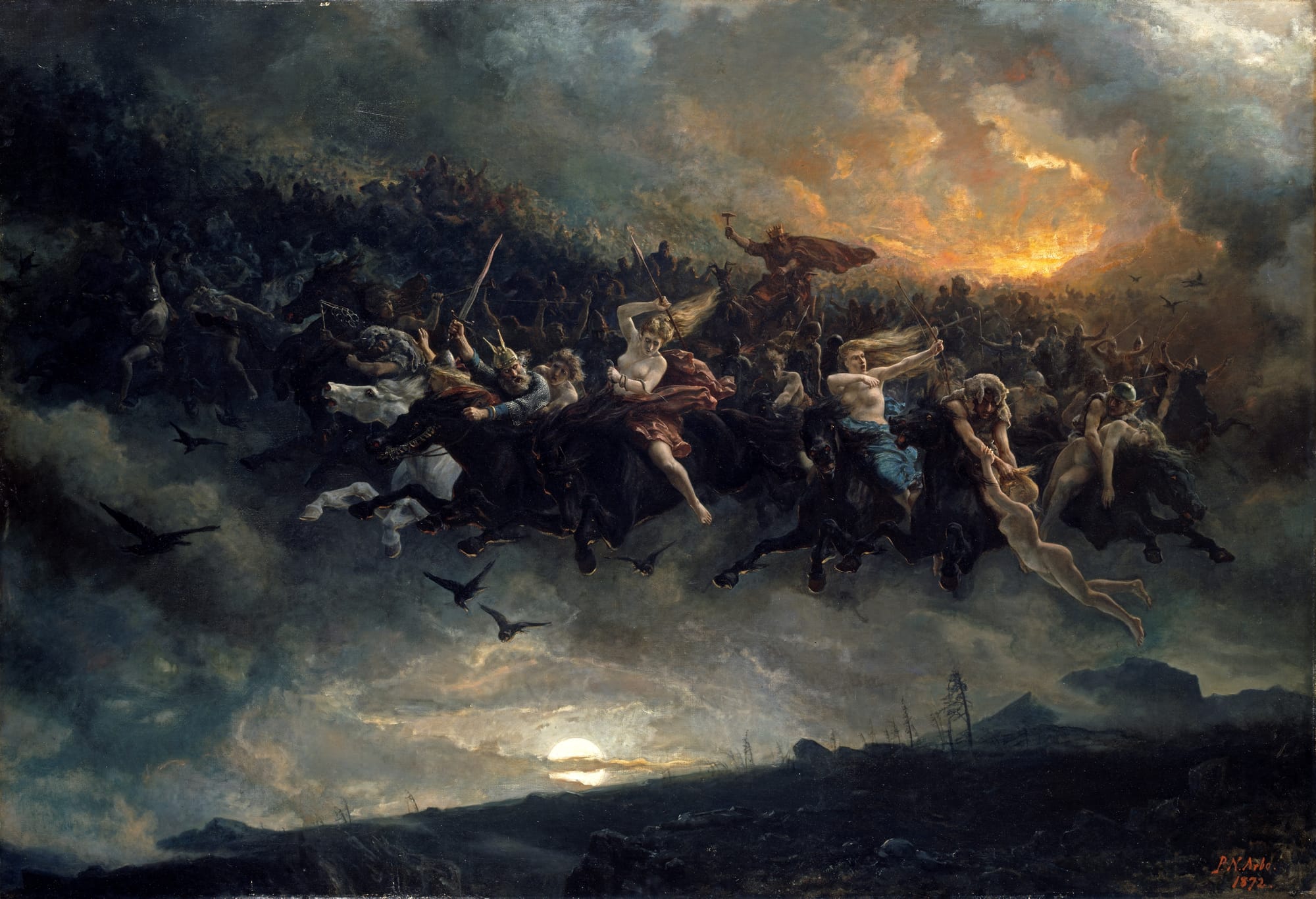
Historical Threads: Queer Holidays, The Cailleach, and the Wild Hunt
Before Christmas hardened into a singular story, midwinter in much of Europe was marked through a weave of household rites, communal feasting, and informal observances that rarely belonged to priests or kings. Much of this work — tending fires, preparing food, keeping time through song and repetition — lived in domestic and communal spaces historically associated with women and those outside formal authority.
Gender nonconforming figures, seasonal fools, and ritual inversions appear repeatedly in midwinter traditions, suggesting that the longest nights were not about order preserved, but about order loosened: roles blurred, labour redistributed, survival made collective. Christianity did not erase these practices so much as absorb and discipline them, drawing sacred attention away from hearth, body, and land toward doctrine and hierarchy. Remembering this unsettled pre-history allows midwinter — and the slow return of daylight — to be reclaimed as a time shaped by care, improvisation, and relational knowledge rather than certainty or control.
In northern European lore, the Cailleach reigns over winter: mountain, bone, and weather. She embodies the land’s cold authority. If you want an archetype of fierce resistance, rage, and survival, she is screaming in the wind for you.
Stories of the Wild Hunt in various folkloric traditions Northern Europe speak of spectral processions in the longest nights — scary stories for shivering close together, but also mythic lessons in reckoning, accountability, and movement when the veil thins.
Alone or together, these threads remind us that winter is a time to witness, to hold balance, and to call in justice.
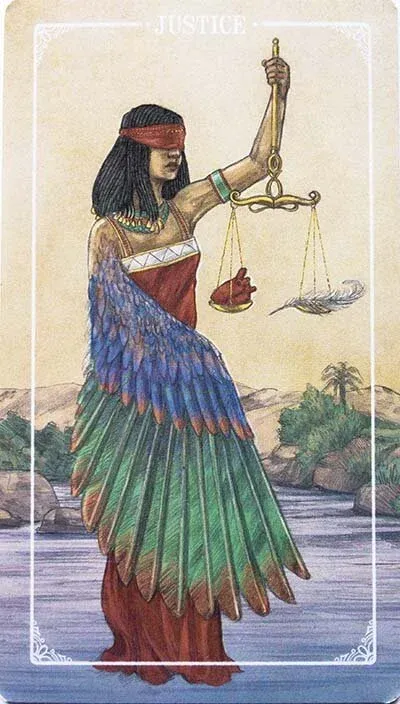
The Justice card in the Tarot shows up at the New Year, especially for solitary practitioners, reminding us that discernment, ethical clarity, and measured action are self-craft, world-craft.
The Ancient Egyptian Goddess Ma’at lives in the Justice card, and in the layered history of reclaimed magical craft. She balances the heart against her feather and determines the path of one's soul.
While Tarot as we know it is a medieval European creation, many of the ideas it works with — justice, balance, measure, fate, and ethical order — have far older roots. In ancient Egypt, concepts like Ma’at named a living principle rather than a law: truth, balance, right relationship, and the maintenance of cosmic order through daily action. Ma’at was not enforced by belief alone; she was practised through attention, speech, and care.
Later Western esoteric traditions, including those that shaped Tarot symbolism, drew heavily — and often imperfectly — from Egyptian philosophy and imagery. Nineteenth-century occultists romanticised Egypt as a source of hidden wisdom, sometimes flattening or distorting what they touched. Still, beneath those layers, something enduring remains: the idea that divination is not prediction, but ethical orientation. To draw a card is not to escape responsibility, but to ask how one might act in better balance with the world.
For witches practising alone, Tarot can be held this way — not as spectacle or certainty, but as a quiet dialogue with justice, truth, and the work of living in right relation.
At New Years in particular we can call on Ma'at to help us reach for balance, for a future that tilts towards justice for all living beings. We can watch the sky and envision the Wild Hunt coming for all those who distort and abuse. Hold space across ancestral time, call in justice, and participate in the careful work of ethical magic.
Gentle Christmas Rituals — For Limited Energy and Quiet Attention
These practices invite presence. They are not obligations or performances. Do less than you think you should. Rest is part of the work.
Mark-Making Without Pressure
Lie or sit comfortably, lights dimmed if possible.
With your non-dominant hand, make marks — a pentagram, a rune, the first letter of your chosen name, lines, circles, words you can't yet say.
Trace shapes on a pillow, fabric, across your skin, along the walls of your space, or in the air above you. The gesture is the work.
Intention: Let the body speak before the mind edits.
Hiding Notes in Place
Write (or dictate) short notes—one sentence each.
Hide them:
- In house plants
- Beneath a candle
- In a book you’re reading
- Inside a pillowcase
These are seeded truths for the year to come.
Intention: Entrust the season with your words.
Rituals for Those Surrounded but Unseen
If you are near people whose worldviews flatten you, these practices can be done quietly, without explanation:
- Carry a small stone, root, or bark piece in your pocket. Touch it when confrontation feels dull.
- With a fingertip, draw a small symbol on your body (with water or scent or oil). This is not decoration, but remembrance of interior life.
- Altar the emphasis of words in shared prayer to highlight the sacred everywhere - daily bread, light, peace, joy, star.
- Make a fruit plate for the family table in the shape of a spiral, a star.
- Give gifts of beloved books you already own, hand-stitched, thrifted, poems you wrote, teas you blended, candles you dipped. Make donations to the ACLU in your racist uncle's name. Refuse to consume.
Intention: Remember that spirit lives in the flickering cells of every interaction.
Winter Plants as Teachers: Bark, Bud, Seed, Root, Leaf
Working with plants at Christmas and New Year isn't just decorative. It can be relational. These plants have moved through climate, trade, conquest, medicine, and ritual for thousands of years. When we touch them, we are touching long human attempts to survive winter—materially and spiritually.
Cinnamon — Bark, Heat, and the Edge of Survival
Cinnamon is bark, peeled from living trees native to Sri Lanka and parts of South Asia. It has been traded for at least four thousand years, moving through ancient Egyptian embalming practices, Greek and Roman medicine, and medieval European winter tonics. Because bark can be harvested without killing the tree, cinnamon carries a teaching about taking warmth without total destruction—a lesson often ignored by empires that sought monopoly rather than relation.
Historically, cinnamon was associated with circulation, digestion, and protection against cold and damp. Symbolically, bark holds the threshold between inner life and outer exposure.
Simple ritual (5 minutes):
Hold a cinnamon stick or smell ground cinnamon. Place one hand on your chest or belly. What warmth am I allowed to keep? Breathe until your body answers.
Extended ritual (over several days):
Add cinnamon to your morning coffee throughout the liminal days. Smell and speak to it, welcome it and ask what it needs you to know. Each day, note where warmth appears—physically, emotionally, relationally. Write a single sentence each day about how you conserved or spent energy. On New Year’s Day, read the sentences aloud and thank yourself for endurance.
Clove — Bud, Containment, and Held Potential
Clove is a dried flower bud from trees native to the Maluku Islands (present-day Indonesia). For centuries it grew nowhere else, making it one of the most coveted substances in the world. Entire islands were reshaped by colonial powers seeking control over clove trade. Medicinally, clove has long been used for pain relief and preservation—both bodily and material.
As a bud, clove holds potential that has not yet opened. It teaches restraint, containment, and the power of waiting.
Simple ritual:
Place a single clove in your palm or mouth. Hold it there briefly. Ask: What is still forming? Return the clove to a small dish.
Extended ritual:
Keep a small bowl of cloves visible through the season. Each time you feel pressured to resolve or decide something prematurely, touch a clove and pause. Pierce the clove into an orange to hold potential in sweetness. Let some things remain unopened. Make patterns.
Nutmeg — Seed, Desire, and Dangerous Wanting
Nutmeg is a seed from the Banda Islands, once so valuable that European colonial powers fought brutal wars to control it. In small doses, nutmeg has been used in medicine, food, and ritual to warm the body and calm digestion. In larger doses, it is disorienting—reminding us that desire without restraint can destabilize.
As a seed, nutmeg carries the entire tree within it. It asks questions about what we plant, what we extract, and what we are willing to destroy to obtain what we crave.
Simple ritual:
Hold a whole nutmeg, or a pinch of the powder in your fingers. Feel its weight, the way it slips through cracks. Ask: How am I being asked to move differently, desire differently? Place it somewhere dark.
Extended ritual:
Rub nutmeg onto a candle, and sit within it's circle. Journal about desire—what feels nourishing, what feels compulsive, what feels imposed.
Ginger — Rhizome, Heat, and Underground Persistence
Ginger is a rhizome, an underground stem that grows laterally rather than vertically. It has been used across Asia, Africa, and the Middle East for thousands of years to aid digestion, circulation, and immune resilience. Ginger spreads quietly beneath the surface, teaching survival without spectacle.
Ginger appears in many of the sacred recipes transmitted by Hildegarde of Bingen. It is the plant of those who continue, even when unseen.
Simple ritual:
Sip ginger tea or imagine its heat in your through, opening your lungs. Place your hand on your lower belly. I continue.
Extended ritual:
Keep ginger as a daily companion during the liminal days—tea, broth, or scent. Each day, note one small act of persistence you made without recognition. These are not minor. They are structural. You are rhizome, you build the world.
Bay Leaf — Leaf, Vision, and Quiet Intention
Bay (Laurus nobilis) has long been associated with prophecy, protection, and poetic vision. In ancient Mediterranean traditions, bay crowned seers and was burned to invite insight. In broth, bay simmers and diffuses, it's not for eating but it reaches the farthest corners with subtle change. Bay represents breath, message, and subtle direction rather than force.
Simple ritual:
Write a single word or wish on a bay leaf. Slip it under your pillow on Christmas or New Year’s Eve. Let dreams do the work.
Alternative:
Burn the bay leaf safely and watch the smoke rise. Release attachment to outcome.
Extended ritual:
Keep the bay leaf beneath your pillow for the full liminal period. Each morning, write one line about what you noticed—dreams, sensations, resistances. On the final day, thank the leaf and return it to earth or flame.
Choosing How Much to Do
There is no hierarchy of ritual here. A single breath with a spice is enough. A week-long practice is also enough. Winter wisdom doesn't reward excess. Listen for what actually matches your body, your capacity, your moment.
Above all, honour your inner child.
If you are sick, grieving, disabled, or simply tired, let the simplest version be the most sacred. If you are alone and able to stretch into time, let slowness become a companion.
Both are forms of devotion.
New Year Threshold
New Years isn't ever a clean slate, is it? It is a hinge — an interstitial moment where the old year still has weight and the new year’s shape is unfurling.
If you are awake at midnight, sing or chant a tone, phrase, or prayer. Others doing the same tonight — in different time zones and bodies — are joining in the invisible chorus. Imagine tuning yourself to a song woven in waves of light, amplifying.
Work with tarot, cards, runes, bones, pendulums, journaling, or simple listening. You could ask:
- What part of me survived this year?
- What quiet truth is ready for my attention now?
- What can I carry forward as medicine, not burden?
- Where am I called to restore balance this year?
- What kind of ancestor am I becoming?
- What does the land beneath my feet need from me in the coming cycle?
Look for orientation.
Gathering Across Distance and Difference
Ecosystems don't obey human-drawn borders. They spill, adapt, connect. In the Missing Witches coven and many online circles, we meet across daylight differences, varied temperatures, and seasonal oppositions.
Our rituals are not prescriptions from any single culture. They're paths toward each other across geography and circumstance, at Christmas and always.
Today...(a community invocation for love and revolution)
By Jasmin Stoffer.
(Read aloud, add your verses.)
Today we are baking cookies with our stepkids
and love is the revolution
Today we are resting in the beautiful silence
and love is the revolution
Today we are grieving the ones who aren’t with us
and love is the revolution
Today we are spending with chosen family
and love is the revolution
Today we are saying “Fuck Ice!”
and love is the revolution
Today we are caring for others
and love is the revolution
Today we are masking in public
and love is the revolution
Today we are donating to https://cripsforesimsforgaza.org/
and love is the revolution
Today we are wrapping gifts
and love is the revolution
Today we are lighting candles
and love is the revolution
Today we are playing music
and love is the revolution
Today we are dancing outside
and love is the revolution
Today we are walking in the woods
and love is the revolution
Today we are sipping mulled wine
and love is the revolution
Today we are gifting friends gender affirming gifts
and love is the revolution
Today we are reading a beautiful book
and love is the revolution
Today we are cleaning and worshipping at our altars
and love is the revolution
Today we are taking a bath
and love is the revolution
Today we are watching Muppet’s Christmas Carol
and love is the revolution
Today we are surviving
and love is the revolution.
Resources for Crisis and Support
If you are in immediate danger or considering self-harm, please seek support now. Below are resources available 24/7. You are not alone, even if it feels that way.
International/Multi-line Support
- Befrienders Worldwide: https://www.befrienders.org/
- International Suicide Hotlines: https://www.opencounseling.com/suicide-hotlines
United States
- 988 Suicide & Crisis Lifeline: Call or text 988
- Trans Lifeline: (877) 565-8860
- The Trevor Project (LGBTQ+): (866) 488-7386 / thetrevorproject.org
Canada
- Canada Suicide Prevention Service (CSPS):
Call 988 (available in Canada) or
text 45645 - Queer & Trans Lifeline (Crisis Services Canada): 1-833-456-4566
United Kingdom & Ireland
- Samaritans: 116 123 / https://www.samaritans.org/
- Shout Crisis Text Line: text SHOUT to 85258
Australia
- Lifeline: 13 11 14 / https://www.lifeline.org.au/
- QLife (LGBTQI+): 1800 184 527 / https://qlife.org.au/
Other Mental Health Support
- Anxiety Canada: https://www.anxietycanada.com/
- Mental Health Commission of Canada: https://www.mentalhealthcommission.ca/
If you can, reach out to a person—a friend, community member, professional counsellor—right now. You deserve care and support.