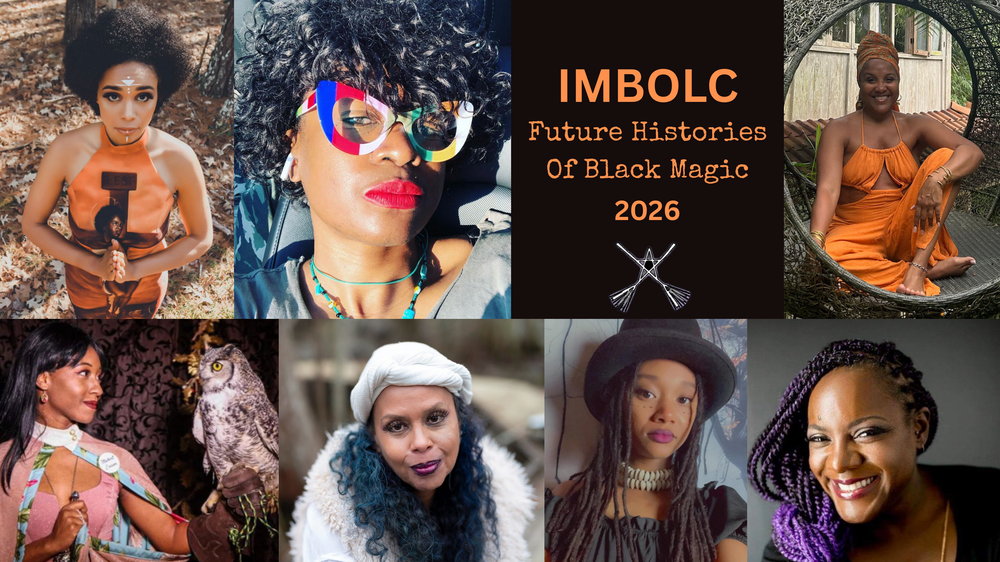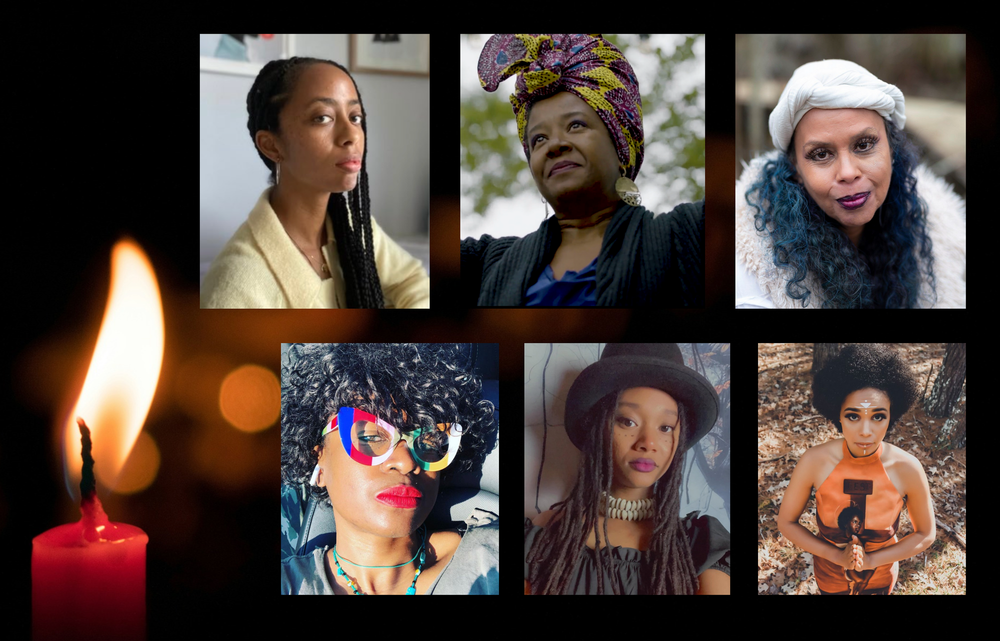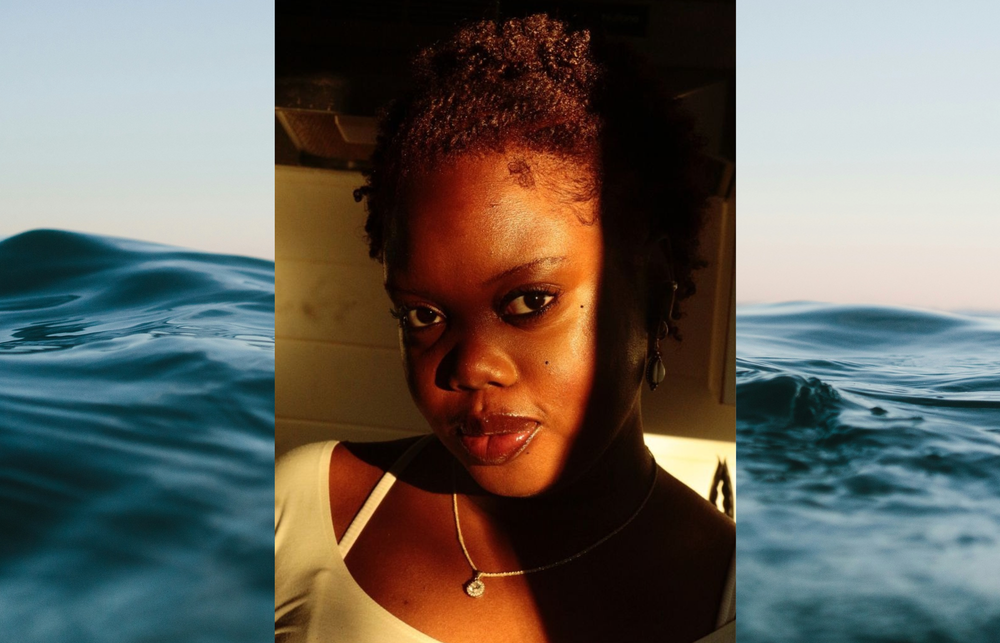
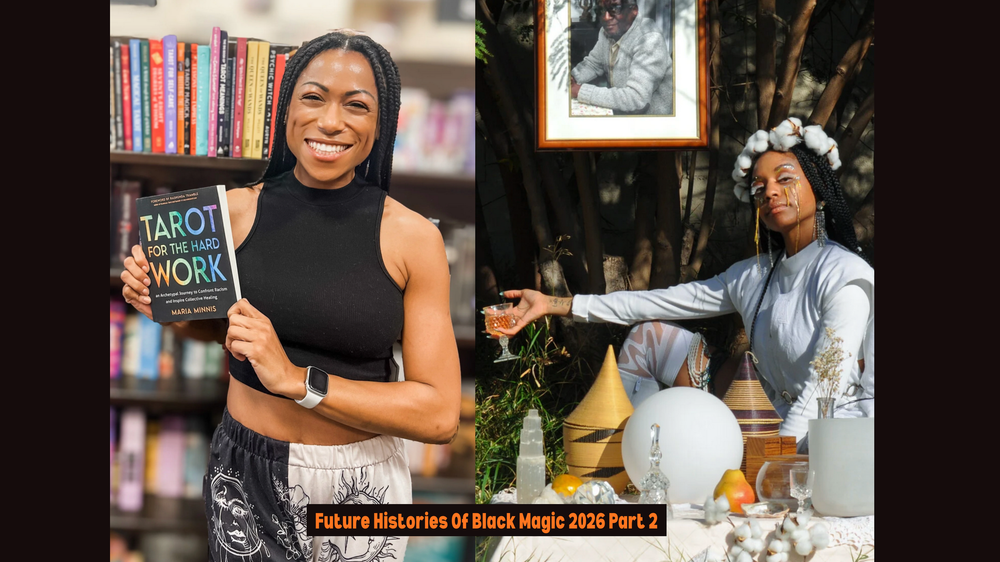
Today we're continuing our celebration of Black History Month joined by two more creators of future histories of Black Magic: Sanyu Estelle and Maria Minnis!
Neither Sanyu or Maria could make it to our Imbolc panel, so we decided to do a little bonus episode, and since both Sanyu and Maria are tarot enthusiasts who have written or are writing books about Tarot, and BOTH contributed essays to the book A Confluence of Witches (ed. Casey Zabala) we knew there'd be A LOT for us to talk about.
Together we nerd out over holographic quantum multi-dimensionality, aspirations for humanity, love, choice, and free will!! The takeaway: what we perceive as possible is possibly more important than what is possible.
Listen now, transcript below:
Our continuing theme for the comes from Nina Simone's song I Wish I Knew How It Would Feel to Be Free, and I asked our guests: How would it feel to be free?
Sanyu Estelle is a card reader, musician, and author of the upcoming The Cultural Roots of Tarot (Fall 2026). Sanyu is also known as "The Word Witch" because of her deep love for word origins (etymology) and word culture (philology). Sanyu is a self described pigmented, womoonist, cissy, flexible asexual, travel-apt and fashion forward SSJW (Sarcastic Social Justice Warrior). She’s also a musician, singer and lyricist - her latest album is 'Ship Wrecked. Sanyu is a tarot historian and card reader who promises THE READING YOU NEED, NOT THE READING YOU WANT. Her book The Cultural Roots of Tarot will be out in Fall 2026, so hopefully we’ll have her back on the pod to talk more about that more next year! In her essay I AM THE FIGHT Sanyu wrote, “Black Liberation does not equate to White Supremacy. IT REMEDIES IT.”
FIND SANYU ON Instagram, YouTube AND Patreon
The root of the word 'free' means To Love. Freedom means to love to choose.
Sanyu
Maria Minnis is a Black, Jewish, queer, and autistic tarot reader of 20+ years who teaches about blending spirituality with everyday magic, liberation work, kink and sensuality. She is the author of Tarot For The Hard Work, and believes that the end result of all magic should be to cultivate a more equitable and empathetic planet.
FIND MARIA ON HER WEBSITE AND FOLLOW FEMINNIS ON INSTAGRAM
Freedom to me means having OPTIONS.
Maria
Celebrate Black History Month by supporting Black Witches!!
🜂 🜁 🜃 🜄
TRANSCRIPT
Amy: If you wanna support the Missing Witches project, find everything you need to know@missingwitches.com.
Intro: You aren't being a proper woman, therefore, you must be a witch. Be a witch. Be a witch. A witch. Be a witch. A witch. Be a witch. Be a witch. Be a witch. Witch. You must be a witch.
Amy: Hi, coven and welcome to another episode of The Missing Witches podcast.
Today we're joined by two more creators of future histories of Black magic Sanyu Estelle and Maria Minnis. Neither Sanyu nor Maria could make it to our in bulk panel. So the three of us decided to do a little bonus episode, and since both Sanyu and Maria are tarot enthusiasts who have written or are writing books about tarot and both contributed essays to the book, A Confluence of Witches edited by Casey Zabala, we knew there'd be a lot for us to talk about.
Nina: I wish I knew how it would feel to be free and we could break all the changes.
Amy: Oh, what a room. What a room. What a room. I'm so excited to be here with Sanu, Estelle, and Maria Minnis. We were talking a little bit about how much overlap there is in both of your work, and so who knows. Maria, you are the author of Tarot for the Hard Work, and Sanu has a deadline breathing down her neck for her book, which working title, the Cultural Roots of Tarot.
Sanyu: Correct
Amy: Right. So, okay, before we get into all of this, um, I wanna start with this. Usually I end with this, but this month we're starting with it. So let's start with Sanu. Who are you? How are you, what are you working on? What are you not working on? And most importantly. How can our listeners support your work?
Feel free. PayPal Cash app.
Sanyu: Oh, how lovely.
Amy: Okay.
Sanyu: Yes. Let's start's hear it with the business. Uh, I am San Son Estelle. Depending on the a of your cultural preference or, uh, social conditioning and, or we should call it socialization, I guess. Social conditioning is typically associated with like the bad aspects of humanity, um, where socialization is like our culture itself.
Um, I am a soon to be published author of my own book. In fall 2026 off Red will Wiser 'cause I, I am writing this book, the Cultural Roots of Tarot. The question of what I'm not doing is definitely, uh, a funner way more fun to way to answer because I'm not writing my speculative fiction stories, even though I have ideas there.
I'm not rolling out my methodology workshops that I plan to be rolling out later this year. I'm not purchasing my return tickets from Europe where I'm going in May. 'cause I'm also going to Tunisia to see Carthage just 'cause I want to see it. Yeah. And um. And I'm not planning what I'm doing for my birthday, which is March 5th because my deadline's March 1st.
So until March 1st there's the, there's no birthday. Um,
Amy: but I imagine March 5th will be a really good party if, when you hit that deadline and then you're past it. Yes. That's assuming
Sanyu: I get it done for myself and me that I am on the 28th of February gets the shit done between me and, and her. Our tag team process, then yes, March 5th will be a great celebration.
Uh, the past two years I've gone to Six Flags Magic Mountain, which is apparently closing, which is tragic because like theme parks are the one place where you can like literally yell your head off and no one tries to commit you. I think it's a very special place. Um, I think it's very healthy and cathartic to just scream at the top of your lungs occasionally.
Amy: Yeah. Let me, let me inject a little pop culture reference here. Yes. Because I think it was Kimmy Schmidt and she meets her mom, and her mom is like addicted to rollercoasters and she says the same thing. Like, this is where I come to scream and scream and scream and scream.
Sanyu: Yes. And to feel a thrill that you intend to feel that has a, like a marked ending, right?
Maria: Mm-hmm.
Sanyu: Because humanity is like the thrill that never ends, you know? So every day's like, ah, you know, jump scares. Um, there's a few places you can find me at Philosophical Research Society this Saturday from three to 7:00 PM I'll be reading cards in the PRS library, well bookstore, library thing. And I will be at PRS with lace on Valentine's Day doing speed readings.
Also, Edgar Fabian Frees will be there. Um, is it Frees or Diaz? I hope I said that. It's
Amy: Frees.
Sanyu: Thank you. Okay. Frees okay. Yeah. And we will be doing speed readings for all the sweethearts or the lovers or the non lovers just come get read. Um, so that'll be fun.
Amy: Um, is that part of the Taron that Golden, the Golden Dome, excuse me, that Golden Dome School is doing?
Or is this a separate event?
Sanyu: Think so. It's laced as this annual, um, what is it? Los Angeles. Something contemporary arts. So something about contemporary, I'm doing, I'm failing here, sorry, lace. I love you guys. Um, but acronyms and, but they do a Valentine's ball with PRS every Valentine's Day recently, since post quarantine, you know, every, um, and I've been the resident reader there and they have like a ball and a masquerade and people dress up and there's all kinds of like, performances and readings and like performance art.
Um. And, uh, yeah. And then buy my book when it's out. Thanks. That's my whole spiel.
Amy: Um, I need for you to mention your album before we pass the mic to Maria.
Sanyu: Yes. That's so funny. You actually, and Kate and Kristin or asking me about music and today is the, or maybe it was yesterday, it was like the fifth year anniversary of the release of my first album, which feels funny 'cause I ma I made my album in tribute to my father who passed in January, 2020.
He always wanted me to be an artist, which is not something, well, he wanted me to be a musician, which is not something I ever wanted to do professionally. Um, but when he passed I had a lot of grief, uh, to express and we were in quarantine. So I. I wrote an album called Good Grief and um, and so it's the fifth year as of yesterday, anniversary of that album, which you can find on all the streaming platforms, including YouTube and SoundCloud.
Um, if you want to listen to it for free, 99. And I also released a second album in 2024 called Shipwrecked, and that was my attempt to put all of my romantic songs on one album. So like I don't have to do anymore. That was my idea at the time. My Venus is an Aquarius, in case you were wondering. So I released Shipwrecked and that's like a bunch of love songs about different times in my life.
And that's also out on streaming. And those maybe the only albums I ever make. So stream them for the rest of our lives. Thank you.
Amy: I, I love this like interdisciplinary thing where, I mean, I've been thinking a lot about this lately. How many people say I'm going to write a poem or I'm going to do a painting.
But I think for witches it's like a vision. And then we kind of decide what medium that vision is going to take. Is it going to be a song? Is it going to be a painting? Is it going to be a poem? Is it going to be a book? And that to me is like the difference between. I don't know, secular art for lack of a mainstream art, whatever, and which art is that we go like vision creation, whereas a lot of people, I think are looking from the product.
Backwards. You know what I mean? Anyway. Hi Maria. Hi. What are you envisioning? What's your vision for these days? Who are you? How are you, what are you doing? What are you not doing? How can people pay you?
Maria: Yeah. Oh wow. Uh, so I'll start with, uh, the fact that I'm not doing a ton in terms of like witchy work.
Um, Sanyu, I am so excited for your no return ticket trip out to Europe. I actually just came back from a no return ticket, uh, Woohoo trip. I spent like almost about two months in Europe and like I travel a lot and I just never have a return ticket. Recognized the privilege and luxury of being able to do that.
But yeah, it was pretty magical. And so I, um, came back home and I'm in the process of packing up an entire house and not having any idea about where, uh, me and my fiance are going to be living. And so I'm just like, really just like moving forward and just following what feels right, even though I don't know what that right feeling is going to result in.
And so,
wait,
Amy: hold on. Let me just get this clear because I'm having a panic attack. You are packing up your house, putting all your stuff in storage, going away for question mark, and then coming back and deciding what you're gonna do. That's so brave.
Maria: Yeah, I am so just like probably both of you all are, um, I am just like very energetically sensitive and my fiance and I just like realized this house just isn't like, there's, there's some sort of.
There's some sort of vibe here that isn't conducive to our like productivity. Um, and just overall, um, like I feel like home should be a sanctuary, um, in terms of my chart. Like I am a Leo and my Leo is in the fourth house. And so like my house is my domain. I like to be queen of the castle. And so I tend to just go for things and accept that I don't always know the like finished result.
And so that's taking up a lot of my energy. But I do still do a few witchy things. Uh, I have my holographic Space Index newsletter, which is, um. It's TMI, uh, quite often I just explore tariff fi the lens of like real life in my real life. Um, I'm an oversharer and it, um, I think sometimes people overshare because there's like the attention aspect of it, but for me it's really.
Like writing is processing for me. I process my feelings and experiences through writing and I find such validation in connecting with people from that. And so I don't do that on a prescribed basis. I just, whenever I have the feeling, I just put out a newsletter. Um, I also, in, in terms of other projects that I don't have a regular schedule, I, um, produce my Kinky Tarot podcast, which explores the world of kink and tarot.
And that sort of aligns with what is taking up a lot of my focus lately, which is I am currently studying to be a sex. Intimacy and relationship coach. Um, and my focus will be on kink and neurodivergence as well as friendship. And so that takes up a lot of my energy and so lots of moving pieces. I'm not doing, um, I'm accepting collaboration requests, but I'm not doing the regular workshops and tarot readings and such.
And it's been really freeing and I feel like, um, I'm really excited for my work to evolve after I'm done with the sort of high, uh, high unpredictability phase of my life.
Amy: Tell me about this word holographic and what it means to you and your magic, your life, your work.
Maria: Yeah. Um, several years ago I started using the word holographic a lot in my work.
And I, um. I know that there's often a negative connotation with the word complicated. Um, but I think that so much of life's beauty is, um, rooted in the fact that there are so many layers to everything. And I think that there's real value in perceiving a thing, but also taking into consideration the types of light, um, angles of light, areas of light.
And in that, in that thing as well as the shadows and, and looking at things and, and looking at things more than face value, which I think is a lot of what witches do. And so I really appreciate just approaching life in a complicated way and adding texture to. Everyday things, whether that's conversations, tarot readings, um, relating to a blade of grass.
There is so much to explore in, um, in a lot of the mundane aspects of life, which is a lot of where my public work is rooted in is everyday magic and magic in the mundane. And I feel like the most magic is what we do beyond the altar. And so holographic to me is just like exploring the magic in the everyday.
And a lot of that requires us to take different perspectives on things that we might take for granted or take for face value and deriving meaning from it and understanding that, um, just like the tarot, like yes, there's value in, um. There's value in understanding the collective meaning and language around the tarot because there's a real energy to that.
But also having this personal relationship and personal meanings to everything. And like, that's why I feel like my life is magical, is because I approach things, um, in, in sort of a multidimensional way. And, um, it's in my nature to kind of make everyday things sacred. And I find that exciting and I love my life, and I think that's because I, you know, not always, but I, I strive to take into consideration that most things are, um, most things that I encounter in my personal life are often not what they seem at first.
Amy: You used the word, you used the word multi-dimensional, and I feel like sanu, um, jump in with quantum witchcraft and the multi-dimensionality of your life.
Sanyu: Yes. I mean, if we're talking about it, let's say from the quantum perspective, or if you prefer the Bashar perspective, like all time exists at once, right?
So, Ooh, as a, as a raven flies up from the ground onto a tree. That's my, it's one of my animal guides, one of my companions that I love very much. But, um, all time exists at once. And so the difference between, I've been saying this recently actually to clients like. One. I know it has Gwyneth Paltrow in it, but the moving, sliding, the movie sliding doors is very useful as an analogy for Multidimensionality because in the movie, her character makes one choice that changes the course of her life, and the movie splits into two timelines, and at the end of the movie, she has to decide which version of herself that she is.
Right? So I think of that as multi-dimensionality. And the way I use, give that example practically to my clients is there's a version of me 15 years ago who heard Tarot Deck. That's one dimension. There's the version of me 15 years ago who heard tarot deck and bought a tarot deck. It's the second dimension.
There's a version of me who heard tarot, bought a tarot deck, used it. That's a third dimension. And then there's this fourth dimension, which is, I heard it, I bought it, I used it for 15 years and now it's my profession. And likely the version of me in the parallel timeline called 15 years ago is hearing me be like, girl, I think a tarot deck would be cool.
Like, I don't know, 15 years from now we're doing like cool shit with it. So maybe you wanna buy a tarot deck. And for her it is, it's not comprehended why she would hear that. But for me, with the lived experience, with the field work, with the knowledge, I know why. So I'm the one like calling over to her in non-linear time.
So that's how I think about multi.
Maria: I am nerding out so much. Like one thing I don't often talk about, um, is. Like, my interest in theoretical physics and quantum physics and like my understanding and exploration of those topics is absolutely why I am like so, so into my spirituality and like the concept of many things being true at once, many things occupying the same thing, same space at once, like that is magic to me.
So like when you were just talking about these different timelines, I'm just like, like my, my heart is just like glowing right now and I love learning that about you.
Sanyu: Yes. Likewise. I also tell people, um, what were you just saying? Many things are true at once. Oh, right. That I'm a sossay, I'm a truth teller by trade.
Right. But. People are, when when people read that, it's always very interesting because they project their idea of the truth onto me, right? Which is often fear. People are like, uh, I don't wanna hear anything bad. I'm like, why would the truth be bad? You know, like the truth, the truth isn't your inner critic.
Uh, that's not the truth. Um, but I do tell people a part of being a sosay is recognizing all truths are true from a different perspective, right? Like for the flat earth. That is true for the scientist who sees the earth as a globe. That is true. And existence is making space for both, right? The KKK member and us are true.
They have their beliefs and we still exist. You know, so, and by the way, you can't have a belief about something unless it exists. So they're welcome. But like all these aspect, aspects of reality being multidimensional, truths being held at the same time, even though humanity really doesn't think it's possible, even though it's already happening.
Humanity's like we can't coexist and existence is like, but you are, you know, you already are. Or else, how would you be aware of the fact that you're coexisting? Hmm. Hmm, multidimensionality.
Amy: Let's give our listeners a little bit of context in, in case you didn't know, coven, um, Sanu and Maria both contributed an essay each, um, to the book, A Confluence of Witches, A Modern Witches Anthology, which was compiled and edited by Casey, Casey Za.
Um, and it's fantastic listeners, if you don't have this, these essays, again, I'm sitting with two of the essay writers right now. Um, to give you a little sense of the amazingness, uh, assign you, your essay is called Loving What is Colon Quantum Witchcraft? And again, Maria, I thought of you saying like, I love my life.
You know, the world isn't perfect and nothing, nothing is perfect, but I love my life and loving what is as opposed to, um, grieving of. Grieving a fantasy, you know, missing out on your life because you're grieving a fantasy of something, or the opposite, like grieving your life because you think that your inner critic is the soothsayer, is the truth teller.
Yeah. And Maria, your essay is called All Moons Are for All Lifetimes, and you talk about like, you know, the earth and time and geography, but I think we could apply that to quantum witchcraft too, right? All moons are for all lifetimes. Let me just read something really, really quick. This from your essay, Maria, the Moon reflects the simplicity.
Did I say that? Cyclicity of being human water makes us human. Creativity makes us human. The food of the earth makes us human. The moon is a thread that connects us to our inherent interconnectedness with everyone who has ever existed. And does that apply to other versions of ourself too, Maria?
Maria: I, I think so.
I think so. I think about the moon in its like most basic relationship to humans, which from my perspective is its, uh, impact on our water, which all people have to have a relationship with in order to survive. And. I think about how, how do I say this? Um, so if I am interconnected with all people across, you know, history, then somewhere in that I have a relationship whether I am conscious of it or not, and most of it, of which I am not conscious.
I have a relationship to the truths that everybody holds. And that is, that's exciting. It offers me a sense of responsibility in terms of how I show up in the world, but I can also see it as something, um, a little bit scary. It could be a little bit scary, you know, like I live on a planet where I. Have a relationship to people who hold truth that are vastly different from my truth, truths that are inherently harmful, inherently oppressive.
And what do I do with that? Um, I, I don't have the answer. I can just pay attention to how I show up, but it does make me think about like, okay, if I'm connected to all people, so I'm Jewish, and recently we just celebrated to the Shabbat. I can never pronounce it, but it's the new year of the trees. And oftentimes we consider humanity as like part of this tree of life.
And I am responsible. For my branch, but my branch is always impacted by the other branches on the tree that are acting, uh, that are growing from, from those perspectives independently. And so how do I, how do I consider myself as an independent being while understanding that I am part of this giant tree?
And how do I live my life in a way that, that, uh, that offers myself self preservation? And at the same time, I have to just as much value collective care and taking care of. This whole big web of things that I am not consciously aware of. And that's a big question. I don't have the answers to it, but there are so many ways to be human and that gives me permission to be human in my own way.
And when I say my own way, that isn't to say that I am not the product of I am, I am not. I'm not independent of what brought me here. The tiny minute choices that brought my ancestors together. Like I'm sure one of my ancestors took a wrong turn and met the love of their lives. And without that, I would not be here.
And so it's like I'm, I'm often wondering how my tiny interactions within myself ripple out into the world because I think that everything we. Do ripples out infinitely. Um, and we just like, I don't know what's the end of my moving journey? I'll never know the end result of my actions, but I can act as though the end result of my actions, um, can lead to a, um, a more equitable, equitable future for all.
But I also, I balance that with understanding that like I can't carry the weight of the world and that my ability to access things like joy in a world that is, uh, often not joyful is, is it's self preservation. And my joy can ripple out into micro interactions that impact the whole tree of life. And so again, it's that many things.
Are present at once. Many things can be true at once. And it's this complication that I think makes life, uh, for me worth, worth living.
Amy: Yeah, it's, it's, I mean, I think all the time about like the butterfly effect, and we talk about it in terms of time travel. If you went back to the dinosaurs and you stepped on a butterfly, you'd come back to a completely different world.
But we don't talk as much about today. You don't have to go back in time to be doing a butterfly effect. We have to be conscious of our actions and be thinking a thousand, a hundred thousand years forward, how is this minute decision that I'm making right now going to play out a thousand years from now?
And I also, I want to turn this question to Sanyu because. I think, I mean this is not new by any stretch of the human imagination, but I think 2026 came bucking out the gate and people are being confronted with this idea of self-preservation versus community care. As if these two things are sort of like set up as you have to choose one or the other.
What, what's going on with you in 2026? Like, we know monsters are real. We have, we have the papers. We know.
Sanyu: Well, I mean, you just, you just read history to know monsters are real. I mean, I a book part of the cultural roots of tarot, which I, I, I align with this. Um, I don't know what the proper like English term for this, but like that the book writes itself.
Um, and so I had, you know, I pitched my idea, I had my. My outline or whatever. And like as I'm doing the reading and the research, the book is, is telling me what it, it will be. And so a lot of my research for my book, which there's a great deal of like, honestly like 40 plus sources of things, um, because I'm looking at a big swath of time, primarily like 900 CE to like 1500 ce.
But that has to also include, depending on the topic and the country we're talking about, um, anywhere before, like before the crucifixion of Jesus, which whether we're calling it BCE and CE or BC and ad, it's still based around this, this murder. Okay. So, um, this RO murder by the Roman Empire. Okay. And so. L reading history.
Okay, let me give you an example. The some decks I thought I'd never buy because I didn't b learn tarot through a school or through a tradition. I, I came to it and I learned it intuitively. But now I have the, so Lab, Boca Tarot, right? And I have the Visconti four, I have two of the oldest tarot decks in the world.
And just reading in the books and then reading some, uh, Michael Dume, I was like, oh, this dude married his family member. This dude married his half his bastard daughter. Um, and they did that so they could keep the name in the family right after certain people died. And this guy also had the woman, the wife, before he married his own daughter killed.
So, you know. This is epigenetic. You know, it's not,
Amy: monsters are not new.
Sanyu: No. We've been making up stories about them for millennia. And here's the thing for me too, um, as a sossay, because I know all truths are true from a different perspective. And because I know that existence co-signs me and cosigns the KKK member, and we are both free to choose what we believe.
You know, you're not free if you're not free to make poor choices, right? Like, if you're not, if you, if you don't have the liberty to be dead ass wrong, you're not free. So the having the choice is a sign of, for me, from existence, that's a sign of faith. You know, that's a sign of trust. Uh, or at least it's a sign of confidence.
Like if existence isn't worried on a level, I'm like, I guess I don't really need to fucking worry on a, on a level. Like, I didn't make all this shit. I didn't put everybody here. So it, there's a greater orchestration here happening than me. But like, I, I, I hesitate, I don't even hesitate. I, I don't ude the worst aspects of humanity from humanity.
You know, it, they're not monsters, they're just people doing fun shit. Um, and, you know, not everyone's gonna come through epigenetic trauma and end up like Harriet Tubman. A lot of people just don't have the skillset to do that, or the, the trust, the existential trust. Now that's an, a benefit for sure of being like a witch or a Pagan or someone who truly believes that like all the things here are conspiring together to be in community, um, which is a fundamental belief I have.
But there's also this quality of. Well, what I studied criminology, right? I was like in the Netherlands doing my master's in criminology when I found the herbal Tarot. And then everybody started asking me for tarot readings, and then I stopped doing my master's, and now this is my fucking job now. So a lot of the reason I studied criminology in the Netherlands is because I needed to go somewhere.
In my opinion, my bachelor's was in sociology and political science. So when I decided I wanted to do my master's in criminology, I wanted to be, I wanted to study in a country where crime wasn't a business. Because in the states criminology is forensic science, social work and law. There is no one working with the incarcerated while they're incarcerated unless you are a part of the penology system.
And so when I went to the Netherlands to study criminology and penology, I wanted to go there because prostitution is legal. In taxed, pimping is illegal. You have to sell yourself there. You have to pay dues. There's a fucking prostitutes union drugs are decriminalized. You can not be arrested for taking drugs or for possessing drugs.
You can only be a charged with a crime if you have enough of a quality that they believe you have the intent to sell. You can only be criminalized for selling drugs. Right. And then the Netherlands in general has a very low religious population. Probably LA larger than it was when I was there. 'cause everyone has skewed more conservative.
But like there it was like 15% of the population was religious. Right. So based on a upbringing in the Puritan Protestant. United States or United States of Amer Gove, Bucci as I like to call the country. Then you're thinking, oh, this is fucking Sodom and Gamora bitch. Like this is, they say that if these things were all true at once, like we'd be going to hell in a hand basket.
So I had to go to the Netherlands and see for myself, great quality of life, shit is functioning over there just fine by the way. But they were also at a point in Dutch culture in 2013 where they had had such a low recidivism rate, a such a low rate of criminalization from their native population, that they were renting out their prisons to other countries whose prison populations were growing.
And how does that happen? It happens because there are certain countries who criminalize more things, and there's countries that criminalize less things. And so when we're saying monster instead of human, we're criminalizing an aspect of human humanity that has been going on for millennia, right? Like.
Crucifixions, the Romans crucified like a crazy number of people. It was like 10, 40,000 motherfuckers. They were nailing them to crosses. Okay? These people were alive at the time. The pope, the Popes started because Peter the Apostle, and I gotta read about the apostles 'cause I, those bitches were messy.
But like Peter the apostle went to Rome. He tried, and Jesus was, I know when he had his conversation with Jesus, Jesus said something like, you're gonna get your comeuppance. That's me paraphrasing. I know Jesus didn't say that. And so Peter was like in Rome and then he ran away from Rome. 'cause obviously the Roman Empire was like not down for Christianity.
And then he had a dream about Jesus going back to Rome to be crucified again. And he was like, yeah, you're right. I'm being a little punk bitch. Lemme go back to Rome. And then he got crucified upside down and buried under the basilica of St. Peter. And that is where the first papacy happened. He was the considered the first Pope.
64 CE and then whoever, he had his number two, that became the pope and the tradition of Pope. So like when you're looking back at history, it's full of some of the most abhorrent behavior on behalf of the human species. And yet if we, if we other that to the point that we say it's not a part of who we are, then we're, we're denying a huge amount, number of the population.
And the reason I bring up that these guys were dealing with not only, you know, pedophilia, but incest is because. Epigenetically. I think a lot of people actually deal with these issues. And for me, I don't advertise that I work with people of any particular kind, but I have attracted a great number of clients who have dealt with either incest or pedophilia or things like this.
It's not a personal experience that I've had. I've obviously studied things that allow me to have a, a comprehension of it, but it is way more common than any. It's not just these fucking Epsteins, okay? These are just people, your neighbors, okay? These are people in your family, okay? And people know this because now that they're getting DNA tests, there's a lot of people who are realizing that they're like the results of cousins or, or molestation, or they're related to their own bloodline in a way that doesn't make sense unless there was shit going down in the family line.
And this is something about humanity that has to be exposed. Bashar calls 2026, the year of disclosure. That everything, it's not just aliens are out there, we're not alone in the universe. Live along and prosper. It's also like there's a lot of shit going on that y'all are in denial of and the, it's gonna be to a level of exposure.
Like you cannot, if you wanna be in the cult of deniability or what I call bad Jedi, where they're like, it does not exist, don't ask, don't tell. They're already here. Like, you know? So that I would say yes, there's a very abhorrent versions of humanity that are monstrous. I would call it monstrous, but I think reading about history just shows you how prevalent this kind of behavior is.
And if we can't address it as human behavior, we can't decriminalize it and figure out how to like actually deconstruct and resolve the predilection that causes people to do this seedy ass behavior, which is also a funny word for a derogatory thing. Seeds are great. You know what I mean?
Amy: We love seeds.
Yeah. We need to take back cd. But I mean, you're absolutely right. Um, a a friend of mine is a survivor, um, of childhood sexual abuse, and it, it is her life's mission now to, she works a lot with survivors and, uh, and it's like you were saying, Sanyu, like to lift the veil to use a witchy term, you know, to remove that veil where we think that like, oh, this isn't something that happens a lot.
Like Yeah. It, it's, yeah. It's, and I think, um. So many of us have been affected by it one way or the other. Whether a personal experience or, you know, watching your friend suffer or knowing that that is in your DNA. You know, Maria, you talk about the choices that your ancestors made and how they affect us, right?
Like, we know that our bodies are carrying our, our ancestors trauma. Um, but certainly not new. You know, my sister studied classics and so we're like, okay, Nero, okay, Caligula. Like, is this what we're doing now? We're doing the Caligula thing,
Sanyu: right? Medusa per percept. Like all of these rape victims.
Amy: Yeah.
Mm-hmm. Yeah. Yeah. It's wild out there. Um, alright. Hard left because I know I'm not gonna fix that. Listeners, like how we take the bad I'm not, but I think it's very useful that you remind me, um, that these are human beings. That there are not a different species that. They're monstrous, but they are human beings.
Um, also, um, as we move toward. My final question and the theme of the theme of this month, let me just read something from your essay, the Your Quantum Witchcraft essay, which to me speaks to a level of freedom that I'm gonna ask you, Ben. One second. Not even the invention of humanity, no matter how much it fights to do so, can keep me from experiencing, witnessing, and learning from all that existence is to me, for me, with me, and of me.
I am the only one who is within myself, so I am the only one who can decide. For me, from within myself, what is outside myself. And that seems to me like an answer to the question that I'm about to pose. So Maria, I'll ask you first. This comes from, of course, Nina Simone. Um, she sang a song called, I Wish I Knew How it would Feel to Be Free.
She's saying, I wish I knew how it would feel to be free. I wish I could break all the chains holding me. I wish I could say all the things that I should say. Say loud, say clear for the whole round world to hear. So Maria Minnis, author of Tarot for the Hard Work Adventurer. Um, what would it mean to be free?
How would it feel to be free or with your present circumstance? How does it feel to be free?
Maria: Um.
That, that's a lot. Um, I, I can speak to sort of, um, well, for me it's kind of like a, a big, big, uh, big thing, but like it in terms of like speaking of humanity, it's not, um, personal experience. I, um, spent almost nine years in a physically, um, financially and emotionally abusive relationship. Um, and plenty of reasons I stayed, uh, feeling.
You know, guilt for not wanting to, for, for imagining that I was abandoning somebody, for leaving to, um, to insecurity. Um, and one thing, one thread that I remember having through all of this, and, and I can only say this, I think because I feel the, you know, in, in a strange juxtaposition to the times we're living in, I feel the freest that I've ever had.
And I think the threat that like stayed with me in that almost decade was thinking and believing and telling myself that I did not have options. And I, I think my answer is, um, for sake of time, pretty simple, but for me, feeling free. Is feeling like I have options. And when I think about the work that I have done, um, in terms of collective care, um, I often say, you know, I'm not, I I'm not necessarily, I, I hate the term like fighting for, but I'm not working toward a world where everyone, everyone thrives.
Um, but I'm working toward a world where everyone can choose to thrive. Um, and for me, feeling free feels like I have options. Um, and yeah, that's at, that's at the root of it because right now I feel like, um, like. The, the reason I adventure and, and make choices without understanding the end result is because I feel like I have many options at my disposal.
And again, I recognize the, like, privilege in being able to live a life where I do feel like I have options. Um, and at the same time, um, when I, I'm, and I notice, you know, when I'm feeling down, those are the times when I feel stuck and closed in. And what reminds me of my freedom is understanding that, is remembering that I do have options.
Um, and yeah, I, I have the option to choose to do what I want to do, um, in order to. Achieve my personal and ever-changing idea of what it is to thrive. And that's what I want for everyone, including people who don't, um, have never felt like they've had that, that been able to have that mindset.
Amy: And what would you say to someone who feels like they're stuck?
I feel like we, we all sort of have options, but like executing those options can be terrifying. Um, what would you say to somebody who said to you, I'm stuck and I feel like I don't have any options?
Maria: The first thing that comes to mind is, is recommending that they do the. Tiniest thing possible or that they perceive as possible, um, in terms of remembering or accessing a sense of autonomy.
Um, and that can really be as simple as changing, you know, changing the. You know, time of day that you have, um, your morning coffee, um, and even little things like that helped me get free is understanding that there are ways in which I can shake up my life. And, um, and from there I feel like I'm growing this little sense of being able to access what it feels like to have options from there.
I, I, you know, everyone's circumstances are different, but I, and because I don't understand what it's like to be in anybody else's shoes, but myself, um, I, I understand I can't, you know, prescribe what it is to do, but like, what, this is the smallest thing you can do to feel like you can choose.
Amy: I wanna underscore something that you said that, uh, is so important, um, that it's not just about what is possible, but what we perceive as possible.
That's the major distinction, I think, between how people are living or not living their lives. Sanu.
Sanyu: Yes.
Amy: How would it, or how does it feel to be free? What do you perceive as possible?
Sanyu: Well, first I agree with everything Maria says, um, said ha and probably says as well. Um, but I definitely think like what Maria's saying about the perception of the choice is the same thing I was talking about with Allt.
Truths are true from a different perspective, right? Like there's a version of you who. Doesn't think they have an option, and there's a version of you who's going to choose something and they're gonna find an option to choose. And once you find, you know, once one thing happens one time, it's that much more likely to happen again kind of stuff.
But for me, I have a particular connection to that song because that's the song that we rolled my dad out to on the gurney, um, that Nina Simons is Patron Saint. So it's like favorite artist, musician of all time. However, I had
Amy: no idea. I was
Sanyu: told Oh, I know when I thought it was interesting. Yes. Well, my dad passed on, um, January 23rd, which I always think too of as easy as 1, 2, 3.
Right. Um, and so that song, my dad had many favorite Nina Moan songs. And over the course of his life, various songs would take more like prevalence than others. And towards the end of his life, that was a song that he was particularly focused on. Um, and so that was why we rolled him out on the gurney to it.
Like he had, I had other favorites along the way, but that was the one that he was free, right? Like he wasn't in pain anymore. But also knowing the etymology of free, like the root of the word free means to love literally to love, not love itself, but the, the action of doing so, um, whereas the etymology of love means to desire, right?
So, um, I always tell people etymology of free will means to love to choose, right? It's not to love every choice you've ever made. It's not to love all the choices and present it to you. It's to love the fact that you even have the consciousness awareness to know that there is a choice. Um, because there are people who don't have that, as Maria has said, right?
There are versions of ourselves. Anyone who has left a cult will tell you there was a version of themself who didn't. I think they had the, the will, the, the, the ability to choose that it wasn't for them, that it wasn't in their hands. Um, that they couldn't be trusted with the choice, that they didn't trust themselves.
That they didn't trust existence to support the choices that they wanted to make or the people around them. And, and so freedom means, you know, to love to choose. That's what it means to me. Uh, that song means, you know, the freedom to know more fully, which does not always come at the time of the ask, I suppose.
Right. Um. Like, there's questions we all had in our twenties that our thirties and forties and 50-year-old selves are like, yeah, well duh bitch. Like, that's why Lord three. Um, but that's not, you know, I like to say we're the past lives of our future selves, right? Like when we're in elementary school and we cut out the person and it's a line of people, that's an identity.
And at any given time, you're another person on that line of identity and you're passing the baton every moment. So ideally, the ability to love helps you navigate towards a life that is fulfill with that, or in the pursuit of that, right, the verb of love, not the desire, not a love with a little l, but unconditional love.
And the way I talk about unconditional love with people is it's not about how much affection you have, it's not about how much time you spent caring. It's about the conditions. If the love can't survive the conditions, it's not unconditional and that's not a crime, but it's valuable information.
Amy: Like it's good to know
Sanyu: that like you ain't got the spoons for that shit.
Like it can't be me. It must be, let me release you to somebody who really can deal with this. Or who believes that they'd have to. Right. So I think there's a lot of discomfort right now because people don't trust the species. Not for no reason. People don't trust themselves understandably. Because when you're a part of a species that doesn't trust itself, it you're socially conditioned not to trust yourself.
Um, we're also, oh, this is totally random, but it feels relevant 'cause Maria was talking in the beginning about how she, TMI is in her newsletters. And I think I am the same way too. Like my newsletters come very sporadically, but like I will share whatever, something I've. Been sharing with people recently, even though at one point it didn't seem super relevant, is that I went to high school with Steven Miller, like I was an associate student body with him.
He was like that in high school. Um, I went to a huge high school, 3,600 people. And my, my, he wasn't in my class. He's two years older than me, but like we were in student body together. And so like, there were a thousand people who were in my class and 860 people who graduated. This is a huge school. It is not a Hollywood school where people are being put in trash cans.
This is a big enough campus that you could just beef with your own crew. Like you didn't have to, you didn't have to seek out and anybody else, you could just fight your own people. But why I say this is, you know, he, there's this speech Jimmy Kimmel shows of him at, in our quad in high school that I remember, um, where he's talking about why do I have to pick up my trash when we have janitors and.
We had no idea where the speech was going. But by the time when he, he said janitors, and then he overp spoke his time, and so they walked him off the stage. And then someone comes up to speak who I personally know very well, who was the next person to speak. And Steven Miller runs back onto the stage and like tries to talk over her.
Um, but all this is to say what's really interesting about that speech to me, although is Earth is your house. Like why are you, why would you throw trash on the ground in your house? You fucking live here, you idiot. Like, why would you create work to have, why are you creating problems to have? Okay. The trash cans right there.
It would be one thing if it didn't exist, if someone had not invented the concept of a trash can. Okay? But we know they're there and we know what they're for. So like, why wouldn't we use what, like why would we reinvent the wheel? You know what I'm saying? So I bring that in just because. A lot of people's beliefs about what their options are, are very limited by their understanding of what existence is all about and the focus on what we don't prefer about existence and the fixation on arguing with existence about the fact that the things we don't like exist.
And then attempting to eradicate from reality what something infinite has put into reality. Okay, this is psychotic behavior. Okay? So I think that, you know, freedom to me is recognizing just like Maria says, yeah, love in the time of cholera and love, in the time of colonization, and loving in the time of the holocaust, and loving in the time of enslavement and, and love regardless, right?
Like there's not been a time in history, I promise you, from depending on where you were in the world, where there was not. Something problematic taking place. And so the idea that life has to be right for you to be good, don't hold your breath because that's a dying wish, you know? Um, but to show up anyway to love, regardless of the fact that there are things here that you don't prefer to choose freedom, regardless of how many examples there are.
To the contrary, I think that for me is embodying what Nina Simone sings. 'cause obviously my dad didn't feel that way in his lifetime and neither did she. And many of us don't either. But we aspire to a humanity that does. And I suppose that means that each of us has to do our little part in our own life to like write our own life and to live from a place of like appreciation.
We're not throwing trash on the ground in our house just 'cause we can't.
So,
Amy: and if you, if you believe in reincarnation in any way, even death is not an escape from the mess you made before you left this place. You have to return to that mess at a certain point. Mm-hmm. Maria, do you have any reaction to what Sanyu said or parting words?
Maria: Um, I just spent the, I was just present the entire time. I wasn't processing anything other than just like pure appreciation and resonance with all of that. And yeah, like I. I am, uh, so many feelings, and I know we're at the end of our time, but yes, like, don't throw trash in your own house. Um, because we're all connected and, um, we, we do oftentimes have choices that we don't realize that we have.
And a lot of that just starts from looking around and realizing that this is your house too.
Amy: Yeah. Yep. Um, what you perceive as possible is possibly more important than what is possible. And if we're looking for definitions of freedom, let's go to the etymology and come down to love.
Sanyu: Isn't it refreshing that that is what it would mean?
Amy: Right, like, love it as as soon as we hang up, I'm rabbit holing immediately into, I know you're an etymology witch. My job is done here. So you've, you've done your good work. Um, again, I know that you are both very busy witches and globe trotting and gallivanting and building fantastical futures.
But I do hope that this face-to-face introduction that happened today, may, someday, no pressure, no stress, no timeline, and maybe not even in this lifetime, but will fruit a collaboration. I would love to see what would happen if the two of you were given more than our short discussion Time to listeners.
What's the, what's the English word for it? Magic, I guess. Make magic together again. Um, Sanu and Maria are both in, um, a confluence of witches, which is. Which is listeners just a fantastic, I mean, it happens all the time, right? Which is, which is just a fantastic collection of essays. I mean, Edgar Fabian Frees came up earlier, so pick this book up.
Also, tarot for the Hard Work by Maria Minnis is available now and the cultural roots of tarot, fingers crossed, got Millon and the Creek Don't Rise, will be out in 2026. Thank you so much, Maria and Sanyu for helping me cultivate my understanding of how it would feel to be free. Thank you so much, and I guess blessed fucking b.
Sanyu: Yes. Yes. Blessed. So nice to meet you, Maria.
Nina: To be
all
Amy: you must be a witch.