
Throughout this process of writing meditations on Kinship with the non human world over the past few years, I’ve tended to focus on love - my favourite plant ally chamomile, the freedom of plankton, the deep rest of a bear, the staggeringly beautiful deer that I can see grazing out my kitchen window… but in 2026, the mood seems characterized by a fresh, very 21st century kind of fear.
Fear of the other, a polarized Us vs Them that has seeped via a rapid stream of constant exposure and manipulation into even the thinnest cracks of humanity. The kindest people I know have started cheering for the dropping of bombs, calling for violence to end the violence. Peace movements disappear, replaced by seething angry mobs on both sides of every debate.
So for the next couple weeks, I turn my focus to those fears - war, illness, pestilence, poverty… and my own personal phobia: rats. To retrain my mind and body out of hatred and into understanding. Come back next week for the hissing of cockroaches, but for now, let’s gnaw away at our fears with teeth that never stop growing. Rat teeth.

I have such a strong visceral reaction to even the sight of this animal on a screen that in my childhood my sister decided I must have died of Bubonic Plague in a past life. I’m not afraid of much - heights, spiders, public speaking, none of these things bother me in the slightest, but a single glimpse of that skinny tail and I freeze in abject terror. And much like how we humans have been socialized to think, my fear manifests as hatred and disgust. I see it everywhere - on my timeline, in the streets - how fear turns to anger, how fear turns to revulsion.
So today, I turn to the vast tales and skinny tails of Rats, to discover how we are the same, what makes us kin, what I can learn from them and why I should be grateful they exist. I am human, and the best I can do is to examine my fears, locate them in space, time and in my body, question their validity before scared turns to angry, before scared turns to disgusted, before fear turns to destruction.
I’m gonna work through this, Rat Kin, with you, not against you. Though even in the writing of these introductory paragraphs, I can feel my stomach starting to turn, my skin starting to crawl, I promise not to turn away. I’ll go with you into the dark recesses of your life and hopefully leave my phobia there, underground.
Consider this a training ground, Witches, to take what we learn and use it all as an antidote to hate, as I skulk and scuttle through the sewers of my own mind, to find amid the filth and muck, a warm place in my heart to love a Rat. Today, I am Rat kin.
When I’m looking for love, I often start my search in the realm of poetry - who better than a poet to reframe the way we think about the mundane, rendering the quotidian in the fat of the extraordinary?
The poem I found and share here now made me weep with shame. This is the power of poetry. 300 words was all it took to push me out of fear and hatred and into a place of empathy and kinship with Rats.

For the Poet Who Told Me Rats Aren't Noble Enough Creatures for a Poem
By Elizabeth Acevedo
“Because you are not the admired nightingale.
Because you are not the noble doe.
Because you are not the picturesque ermine, armadillo, or bat.
They have been written, and I don't know their song the way I know your scuttling between walls.
The scent of your collapsed corpse rotting beneath floorboards. Your frantic squeals as you pull at your own fur from glue traps, ripping flesh from skin in an attempt to survive.
Because even though you are an inelegant, simple, mammal bottom-feeder, always frickin' famished, little ugly thing who feasts on what crumbs fall from the corners of our mouths, but you live uncuddled, uncoddled, can't be bought at Petco and fed to fat snakes because you are not the maze-rat
Of labs: pale, pretty-eyed, trained.
You raise yourself sharp fanged, clawed, scarred, patched dark-because of this
He should love you.
Because in July of '97, you birthed a legion on 109th, swarmed from behind the dumpsters, made our streets infamous for something other than crack. We nicknamed you "Cat-killer".
Raced with you through open hydrants, squeaked like you when Siete blasted aluminum bat into your brethren's skull-the sound: slapped down dominoes.
You reigned that summer, Rat;
And even when they sent exterminators, Half dead and on fire, you pushed on.
But look at the beast, the poet tells me.
The table is already full and, Rat,
you are not a right, worthy thing.
Every time they say that, take your gutter, your dirt coat, filth this page, Rat.
Scrape your underbelly against street concrete.
You better squeak and raise the whole world, Rat.
Let loose a plague of words, Rat, and remind them that you, that I, we are worthy of every poem.
Here”
I’m sorry, my Rat kin. Truly. For most of my life my mind and body have reacted to you like a certain President tweeted just a few weeks ago: a whole civilisation will die tonight, never to be brought back again.
And Rat kin, if you had looked at me with your beady eyes and pleaded why? I would have answered, “Because I don’t fuckin like you.” And that would have been enough for me. Destroy every last one of your species, every last breath of your civilisation because I think you’re gross.
I’m sorry.
You are a right, worthy thing, Rat. You and I are worthy of every poem.
For many reasons, but first, because we are Witches, you and me, Rat. And even when they sent exterminators, Half dead and on fire, we pushed on.
Rats and witches end up twinned less by biology than by the stories told about us. We occupy the same charged territory in the human imagination: the edge of the village, the underside of order, the place where control is chewed and frayed.
We are both occupiers of the in-between. Rats live in walls, sewers, thresholds - spaces that are neither fully inside nor outside. Witches do something similar both literally and figuratively: we move between categories, between healer and heretic, neighbor and outsider, knowledge and taboo. We unsettle the neat and tidy boundaries of humanity. Chew holes in the stories that get told.
And then there’s the dark. Rats navigate darkness with uncanny precision, mapping environments we can’t see, they hear things we can’t hear. Likewise, we Witches were imagined to possess secret understandings of herbs, bodies, cycles, forces that operated just beyond official explanation.
Just beyond. Just different enough.
In both cases, Rats, Witches, what is not easily controlled or understood becomes reframed, re-viewed as threatening.
And we both carry the same burden of our societies’ projections. Rats have been cast as carriers of disease and decay, particularly during events like the Black Death, where fear needed a visible body to land on. Witches were similarly made into vessels to hold social anxiety. Easy answers to difficult questions. During continuing global witch hunts, Witches are blamed for misfortune, illness, or unexplained change.
So we Rats and we Witches, we marginalized, we scapegoats share an overlapping experience. Different targets, facing the same terrifying impulse pointed our way: locate danger, find a scapegoat, try to control not the danger but the goat. If it can’t be controlled, a whole civilization dies tonight.
And yet, we are also both figures of resilience. We adapt, persist, consistently outmaneuver eradication. Witches, weirdos and Rats. We represent survival through marginalization - knowledge that endures despite suppression. And they hate us for it.
Rats and witches carry the weight of the human tendency to fear what slips through categories, to perceive a threat and exterminate it.
But you, my Rat kin, are like us outside of the stories we tell. Our commonalities aren’t just metaphorical, they are also biological, neurological and social. We have so much in common. And again, I’m sorry, but we use you for testing precisely because you are so much like us. Or, enough like us to be useful for our studies, but different enough that we feel we can use you and use you up without remorse.
We turn to rats because they sit uncomfortably close to us on the biological, genetic map. Close enough that their bodies echo ours in ways that matter. Beneath the fur there is a shared architecture: organs arranged with familiar patterns, nervous systems that process pain, stress, reward. The same molecular language, spoken with a squeakier voice.
The Rattus norvegicus, in particular, has been bred to become a kind of living instrument in science. It breeds quickly, matures fast, and its genome has been mapped in detail. Researchers can observe entire life cycles in compressed time, tracing how disease begins, unfolds, and sometimes resolves. What would take decades in humans can be glimpsed in months.
There is also control. An uncomfortable but crucial factor. In laboratory settings, variables can be narrowed, environments stabilized. Diet, light, stress, exposure: all tuned with precision. In this controlled theater, rats become translators, helping us understand conditions like cancer, addiction, neurological disorders - fields rooted in biomedical research and genetics.
But the closeness cuts both ways. The reason rats are useful is the same reason their use raises ethical concern. They are not abstract models. They are responsive, social, capable of learning and distress. Their similarity is precisely what makes them legible, and what makes their role in research something more than neutral.
So we study rats because they mirror us just enough to reveal what we cannot easily test in ourselves. Science tells us that we are rat kin.
“University of Chicago neuroscientist Peggy Mason and psychologists Inbal Ben-Ami Bartal and Jean Decety placed pairs of rats in pens. One rat was caged in the middle of the pen, whereas the other was free to run around. In this experiment, 23 of 30 rats liberated their peers by head butting the cage door or leaning against the door until it tipped over.To actually test the rodents’ selflessness, Mason placed rats in pens with two cages: in one was another rat; in the other was a pile of chocolate chips. The unhindered rats could easily have eaten the chocolate themselves. Instead most of the rodents opened both cages and shared the sweets. “In rat land, that is big,” Mason says. This is the first study to show altruistic behavior in rodents.”
“The bottom line,” Mason says, “is that helping an individual in distress is part of our biology.”

Rats belong to the genus Rattus, a branch of the rodent family Muridae that diversified relatively recently in evolutionary terms. Their deeper ancestry traces back to early placental mammals that survived the Cretaceous–Paleogene extinction event, after which rodents rapidly radiated into new ecological niches. Within this expansion, murid rodents evolved in Asia, where the earliest recognizable rat-like forms appeared millions of years ago.
Modern rats, including the Rattus norvegicus and Rattus rattus, emerged through processes of natural selection acting on traits that favor adaptability: omnivorous diets, high reproductive rates, and flexible social behavior. Their continuously growing incisors, a defining rodent feature, allow them to exploit a wide range of food sources and environments. Genetically, rats exhibit remarkable plasticity, enabling them to adjust quickly to changing conditions, from forests and grasslands to dense urban ecosystems.
Biogeographically, rats spread globally alongside human migration and trade, particularly during periods of expanding maritime networks. Ships provided both transport and habitat, allowing rats to colonize new continents.
This close association with humans is an example of commensalism: rats benefit from human environments without necessarily providing benefit in return.
So while Rats have been the subject of much propaganda, often focused on the poor or ‘unseemly’, it seems like they might have more in common with colonial wealthy, expanding territory in abject commensalism: take and do not give back, profit from the benefits of our Earth without ever providing benefit in return.
Emily Dickinson wrote:
A brief career of
Cheer And Fraud and Fear.
Of Ignominy’s due
Let all addicted to
Beware.
The most obliging
Trap
Its tendency to snap
Cannot resist— Temptation is the
Friend
Repugnantly resigned
At last.
Emily’s rat surrendered to temptation, to greed, and got its neck snapped.
But when people call other humans “rats,” it’s rarely about animals at all, is it? It’s a linguistic trap and once someone tries to snatch the bait, SNAP! someone gets recast as vermin: unclean, invasive, expendable. That rat trap has shown up again and again in human propaganda.
One of the most infamous examples comes from Adolf Hitler and the Nazi regime. In films like Der Ewige Jude, Jewish people were explicitly compared to rats, shown in parallel footage with swarming rodents to suggest infestation and disease. This imagery helped normalize exclusion, violence, and ultimately genocide during the Holocaust. More recently, a pro-genocide song calling Palestinians “rats” topped the music charts in Israel for several weeks.
A similar pattern appeared in the lead-up to the Rwandan Genocide. Extremist media outlets, especially Radio Télévision Libre des Mille Collines, referred to Tutsis as inyenzi, often translated as “cockroaches,” but functioning in the same dehumanizing register as “rats.” The message framed a group of people as pests to be eliminated. Come back next week when we’ll shudder our way through our kinship with roaches!!
In wartime propaganda more broadly, including in the United States and Britain during World War II, enemy populations were frequently depicted as rodents or vermin. Posters and cartoons portrayed opposing nations as swarming, gnawing threats. Less than human, easy to hate, easy to want to kill.
Even outside large-scale conflicts, the metaphor shows up in political rhetoric. Opponents are called “rats” to imply betrayal, or moral/ethical filth. The pattern is consistent: reduce a person to a creature associated with fear or disgust, and you lower the psychological barrier to mistreating them.
B. F. Skinner famously used rats to map how behavior is shaped by consequences, that behavior isn’t just reflex but sculpted over time through reward schedules. John B. Calhoun’s Rat Utopia studied the effects of overcrowding.
The experiment that sticks out today though, Rat kin, is the one that proved you have the capacity to hope.
Curt Richter drowned you then rescued you. Then drowned you again. You Rats who were rescued once were able to keep swimming for an additional sixty hours. Curt Richter drowned you to prove that hope is key to survival. A brutal experiment to give us scientific backing for what we knew all along:
Hope is key to survival.
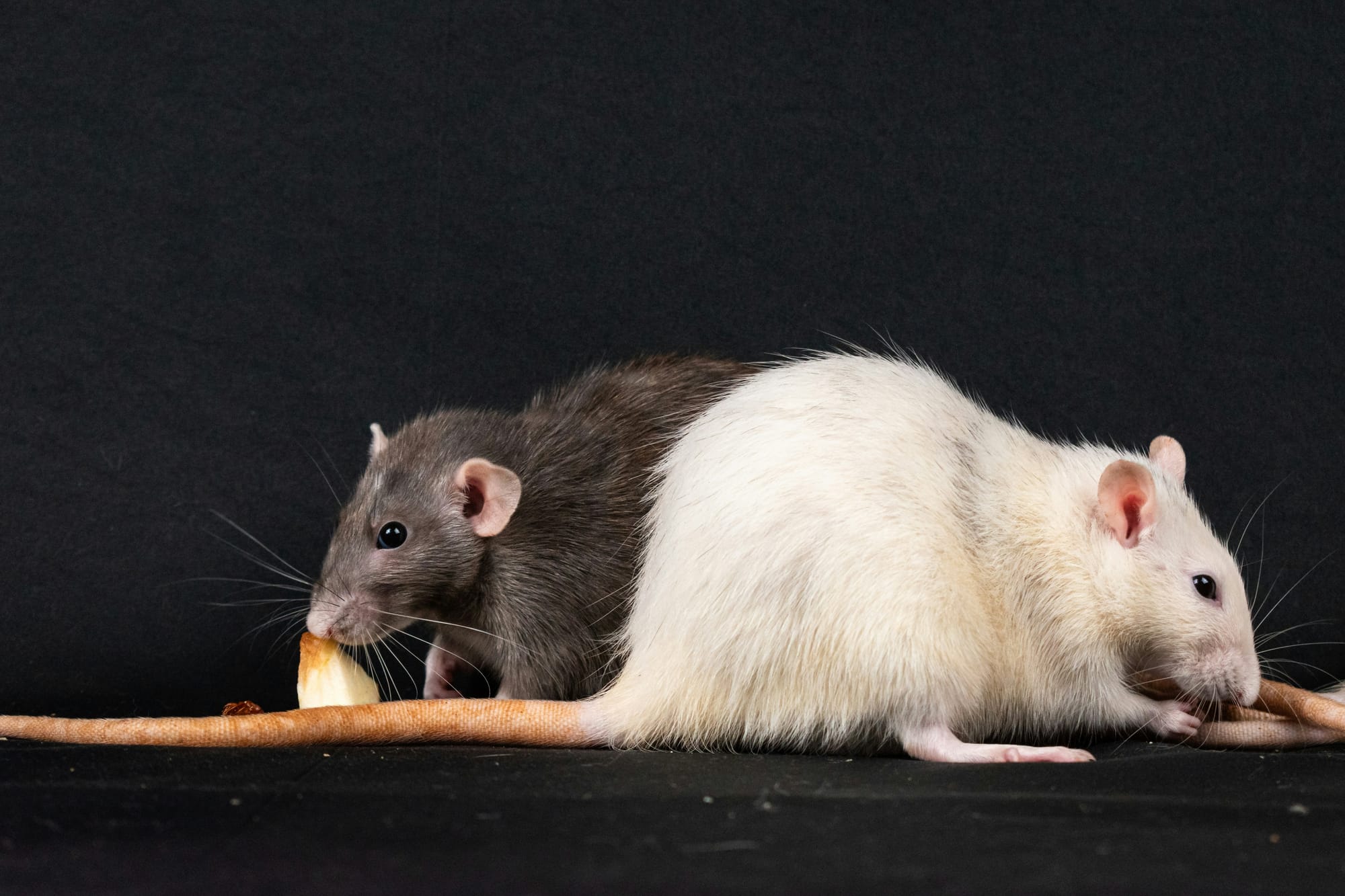
You, my rat kin have taught us humans SO MUCH about ourselves, including but not limited to:
Neuroscience: mapping brain structure, memory, learning, and neural plasticity.
Behavioral Psychology: especially through operant conditioning and habit formation.
Pharmacology: testing how substances affect the brain and body.
Toxicology: understanding chemical safety and exposure risks.
Genetics: exploring inheritance, mutation, and gene expression.
Oncology: modeling tumor growth and testing treatments.
Endocrinology: examining stress, reproduction, and metabolic systems.
Immunology: investigating disease response and immunity.
Cardiovascular Research: modeling hypertension and heart disease.
Addiction Science: understanding reward pathways and dependency.
Developmental Biology: observing how organisms change over a lifespan.
Nutrition Science: linking food intake to physiology and disease.
Biomedical Research: integrating many of these areas into models of human health and disease.
But instead of lauding you, praising you, instead of being grateful for every bit of knowledge and healing that you have provided us, albeit unknowingly and without consent, instead of cradling you in our arms and whispering thank you, we hate you. Take the worst things about ourselves and name them Rat.
I smell a rat, you rat bastard, pack rat in a rat’s nest, I’ll be the first to rat you out.
My rat kin, I’m sorry. We use you, steal you from one continent to the next, then scorn you for being there. You have given us so much knowledge about ourselves and we repay you by making you a stand in for everything we hate about ourselves. The ultimate vermin.
Magic requires shadow work, to face the deep and scary bits of ourselves, and for me, Rat kin, you lurk in these basements. Not because of you, because of me. I fear you, so I’m disgusted by you, so I hate you, and the mere sight of you sounds an alarm inside my body that screams, “EXTERMINATE!” Just like xenophobes and fascist billionaires, I looked at you and said, ‘if I let you flourish, you’ll take over this land that I own and ruin it for me.’ Indeed many dream analysts suggest that to dream about Rats tells us there’s something we’re repressing. Something that we don’t want to acknowledge, and for me it’s this. That I am no better than Rats, and more disappointingly, no better than the people I call Rats if I allow my fear and entitlement to dictate whether or not they are worthy of a poem.
Beneath that another shadow: you aren’t just kin, dear Rats, you ARE us, you are mirrors of us, travelled to the places we travelled to, populated our urban centres right along with us, your biology, physiology and psychology is our reflection, almost all human genes known to be associated with diseases have counterparts in the rat genome , you feel fear, loneliness and hope. From a biological perspective, you are a success story of evolutionary generalism. Rats thrive by remaining flexible. Just like Witches.
Just like us.
New York City is famous for Rats, so let’s turn for help to my friend, poet, librarian, New Yorker, kin, Harmony Birch for her perspective:
We are Rat Kin
I'm struggling.
Chasing dreams and self-actualization.
Why am I always hungry,
yearning?
Tired.
Rushing.
Flip flopped,
foolish and bold.
Pigeon-toed,
I jog.
One job,
one rent,
one chance to not fuck it up.
Flip flop flip flop----Screeeeech.
--Jump. Fly.
Feel the weight lurch. Rise.
Above, suspended.
Rejoice in the weightlessness.
Just you.
Just you and this.
A brain scattered across black tarred road.
A leg twitching.
Proof. Of warm blood.
Tongue lolled,
resting along a sharp jaw.
It's too much.
I won't bear witness.
Instead,
my eyes dart
toward my surroundings--
And lock on to those of a woman.
For a moment,
I wonder if I've been seen--
And I want to laugh.
To wave.
To cling to shared understanding.
To a community,
I'm half convinced is myth.
She shrugs at my foolishness
and turns away.
Keeps walking.
The weight, previously suspended,
crashes down as a wave.
I'm tumbling.
Gulping.
Burning.
Shame. Disgust.
A creature twitches,
and I turn away and run.
I am rat kin.
It's early November, and the sun is warming the chill we've grown accustomed to. I'm bundled on my balcony; it's about 8:30 a.m., and I'm searching for wildlife in the lush, still green, forest of city yards. Something large and round with a long tail scurries toward the house two yards down. I'm surprised by its belonging. Here, in my sanctuary? It belongs just as well as a squirrel. Then I spot another in the yard across from me, and unease awakens. Rats? In the day? I've yet to see them in the yards even at night. Do we have an infestation? Will they make it into my home? On to my balcony?
During early fall, my partner and I went acorn foraging and fastened a squirrel feeder to our railing. Sometimes I talk to a squirrel as he perches at the edge of the rail, looking for food. Recently, I saw a bushy tail scurry when I opened the door to my balcony, and I slowly went back inside. The squirrel, recognizing my invitation, gathered the courage to dive into the feeder, eat some nuts, then dig into each of my four flower pots before he leapt back into the trees. I watched in awe. A rat would have never been treated with such hospitality.
On my way to work, the same day as the yard rat sightings, a third rat stood, his fur raised. He swayed back and forth and staggered in the middle of the sidewalk, obviously sick.
Google tells me that rat sightings could be a sign of a growing family and, though my womb remains blissfully empty, the extension of kin resonates.
There's a surprising amount of wildlife in New York City, but nothing so prevalent or infamous as the rat.
Rats have a loathsome persona in the cultural zeitgeist as cruel, vicious, disgusting creatures. And when I see them--scurrying in front of me, mangy brown hair, bloated bellies, long scaly tails, I feel the entire semiotic Ick.
They live below us. Taking our scraps, our garbage. Creating networks. Packed together breeding and breeding and sprouting out of walls and subway grates.
They say there are five times the amount of rats for every New Yorker. Though that number isn’t substantiated by recent studies. It's not uncommon for borough folk to compare ourselves to these desperate pests that spread disease and plague, parasitically consuming our waste.
We know that, like rats, we live in a rigid hierarchy where only the fiercest rise to the top. And so when our resources get slim and we’re forced to crowd into impossibly tight spaces where there isn’t enough room to be our whole selves and to breathe, we turn on one another. Until, enough of our rat brethren have died to once again go about our short rat lives-- for though rats can live to be three years, most die after only a year.
We call it the rat race for a reason.
My first year in the city, I felt like I had to lose my humanity. Otherwise, I'd lose my spot in the packed subway cars. I'd lose more precious minutes of time. I'd lose my job, which gave me barely enough money to afford my box of a room, overflowing with all of my life's belongings, clutter, and garbage.
Do we not live in the subterranean? All of us New Yorkers clawing toward humanity, toward the American dream?
In 2023, the estimate of unhoused people who live in subway stations in New York City was over 2,000, but the number could be much larger. In 2022, dozens of encampments were found in subway tunnels.
I think about those encampments and the people living within them when I spot coffee cups perched on the edge of subway tunnels. I wonder what their relationship to the rats are? Do they share my ick? Is that the least of their concerns?
Rats are resourceful creatures full of surprise. They hunt, use tools, and show affection.
One study found that rats have a version of laughter.
There's something about being in the heart of capitalism. Something about seeing the greatest heights of American achievement--even though it's often obtained by violent, oppressive means--that awakens possibility. Even the rat knows it's ok to laugh. Despite their short life span, despite their crowded conditions. Even rats know how to innovate to ensure that they survive and thrive in numbers.
We humans may be related to our other mammal kin via a rat-like rodent and we evolve just like our rat brethren.
At the southern end of Prospect Park is a neighborhood that gentrification has yet to fully sink its claws into. Every year, it participates in a contest to see who can produce the greenest blocks. Walking in this crowded, sometimes dirty, part of Brooklyn you might wander into a jungle. Vines burst from window sill planters. Each tree bed is lush and leafy. Vegetables can be plucked and harvested from the street. What if all of the city looked like this?
Like the Highline, magical for its melding of architecture and nature. What if we could eat for free from tree plots and window boxes?
My neighborhood has started the practice of Guerrilla gardening. Summer squash, grapes, tomatillos all ready to harvest in late summer. It isn’t as stunning yet as that Brooklyn neighborhood, and whenever I stop to examine the fruit a neighbor pops up to deter me from harvesting it. We haven’t learned to embrace the principles of abundance yet. But like rats, we are innovating in our tiny spaces, learning how to breed kin, how to live and survive.
Lately, I've been examining my disgust. There are so many parts of me bogged down by shame. Shame for my messiness, my lack of boundaries, my love of winning, my desire for power. There's so much of me that doesn't fit the standards of what I must be in order to succeed in this world. But what if those parts are needed? What if all the qualities of capitalism, greed, competition, and gluttony aren't sinful, they're just qualities of life? Qualities that can be balanced by care, humility, and rest. Maybe there's a means of evolving that allows us to laugh, to live the whole length of our rat lives, to evolve in ways that allow us to coexist with other species. We are rat kin and new ecosystems are possible.

We are rat kin and new ecosystems are possible.
Thank you Harmony.
And thank you Sydnee who turned me on to Ruth Crawford Seeger which led me to her recording of Rat Riddles, an entirely bonkers song-ification of a poem which led me to that poem Rat Riddles by Carl Sandburg:
There was a gray rat looked at me with green eyes out of a rathole. “Hello, rat,” I said, “Is there any chance for me to get on to the language of the rats?” And the green eyes blinked at me, blinked from a gray rat’s rathole. “Come again,” I said, “Slip me a couple of riddles; there must be riddles among the rats.” And the green eyes blinked at me, and whisper came from the grey rathole: “Who do you think you are and why is a rat! Where did you sleep last night and why do you sneeze on Tuesdays? And why is the grave of a rat no deeper than the grave of a man?” And the tail of a green-eyed rat whipped and was gone at a gray rathole.
Here in Rat Riddles lies a haunting kinship question: Why is a rat's grave no deeper than a man's? The gray Rat suggests that all living things are equal in death. The gray Rat says, at the end, you are no better than me. Because you are me.
In your honour, Rat kin, I pledge to feed and nurture a radical compassion that interrogates hate until it admits to being fear in disguise. To interrogate hate until it turns to some form of love. Until it becomes a poem.
There must be more riddles among Rats, among you our Rat kin, and maybe, just maybe, if we pay attention, we’ll find in our answers to those rat riddles a place where fear and disgust clear a path not for hatred, but for curiosity, for understanding, a place where we can hear rat laughter and join in.
Tell me your tales of Rat laughter, dear Coven, those Rats you’ve held as pets, as friends, to help me in this continuing work: to love a Rat.
If there is any chance for me to get in on the language of the Rats, let loose a plague of words, Rat, and remind them and me that you, that I, we are worthy of every poem.
But I think you already know that. As Emily Dicksinson wrote in another poem about you
The Rat is the concisest Tenant.
The Rat is the concisest Tenant. He pays no Rent. Repudiates the Obligation— On Schemes intent Balking our Wit To sound or circumvent— Hate cannot harm A Foe so reticent— Neither Decree prohibit him— Lawful as Equilibrium.
.