At the Spring Equinox, dark and light reach another point of balance on the spinning wheel. Light is gathering, lengthening by the day, but in this moment they meet as equals. They breathe together.
Ostara, Eostar, Easter all gesture to an ancient threshold that reflects an earthly cosmology. They're not just metaphors, but part of a deep time memory from living with the land and feeling life return in every new birthing sprouting thing.
Across the world, other cultures mark this turning of the year in ways that echo the same attentiveness to sun, land, and life: Nowruz, the Persian New Year celebrated for over 3,000 years, opens with spring cleaning, family visits, and ritual foods; in Japan, Shunbun no Hi honours ancestors while cherry blossoms bloom and families gather at graves; in Mexico, crowds gather at Chichén Itzá to watch the sun trace a serpent down the stairs of Kukulcán; and Easter and Passover are both tethered to the equinox, their calendars tracing the return of light through moon and sun.
In honour of the beginning of spring, let's ritualize an opening—for new ideas, new life, and new possibilities for relationship between people who have in common their celebration of the returning light.
On the equinox, day and night stand level with each other, and our shadows—personal and collective—step forward to offer a different kind of sight.
This is a season that insists: things can change.
What Is Ostara?
Ostara is a collage of ancient and new. A neopagan creation stitched with love from traditions that go back into the Palaeolithic discovery and sacredness of equinox.
Long before written calendars, there were stones. There were people paying close attention to the sky and the turning of the Earth.
Across Europe, and around the world, ancient sites hold this relationship between land, light, and time precisely. Massive bodies placed in relation to horizon lines, to sunrise and sunset, to the brief, exact balance of the equinox.
Newgrange
Built over 5,000 years ago, Newgrange is often spoken of in relation to the winter solstice, when the rising sun sends a beam of light deep into its inner chamber. But the structure doesn’t belong to a single day. It belongs to a cosmology.
To enter Newgrange is to step into a body built to receive light.
Knowth
Part of the same complex as Newgrange, Knowth holds its own relationship to the equinox. At Knowth, the question of the equinox becomes something subtler than precision. The twin passages at Knowth catch both sunrise and sunset near this threshold, holding the day at its two edges. Some researchers suggest the site may have done more than mark the moment of the equinox—it may have helped bring different cycles into relationship, tracing the movement of sun and moon together, the long year braided with the shorter rhythm of months.
Observing the moon near the equinox—through these aligned passages—could help people track how lunar cycles fit into the solar year.
A way of staying in conversation with change.
Stonehenge
At Stonehenge, the alignments are more widely known for the solstices—but the equinox carries its own quiet significance. On these days of balance, the sun rises due east and sets due west, moving across the monument in a way that emphasizes its symmetry.
There is a sense of the whole structure participating in equilibrium. The circle holding the horizon. The horizon holding the sun.
At the equinox people come for a kind of a calibration. A reminder that balance isn't static. Life is a ride between brief stable states.
Mnajdra Temples
On the southern coast of Malta, the Mnajdra Temples are aligned so that, on the equinoxes, sunlight passes directly through the central doorway and illuminates the inner chambers in a precise, deliberate way.
Here again architecture is a ritual instrument. Stone and light and ancestors gesture to us from deep time.
What Equinox Stoneworks Sites Remember
These places don’t give us a single, unified belief system. They don’t explain themselves in language we can fully recover. But they offer evidence of reverence for the relationship between bodies in motion and the way that dance calls forth life.
And maybe that’s the continuity Ostara asks us to feel into as Witches, whether we are beginner Witches or experienced practitioners—not to require a straight line of tradition, but a shared orientation, toward the moment where opposites meet and neither disappears.
We gather symbols here: eggs, hares, chicks— symbols of fertility and also latency. The not-yet. The still-forming. Witchcraft is a fertility cult that draws power from the potential and possible to conjure forth new life in all forms.
The Spring Goddess Ēostre
The later Christian narrative reimagines this reverence of the dance between earth and sun as resurrection.
The Anglo-Saxon monk Bede wrote of a spring goddess, Ēostre, whose feast gave its name to Easter.
In Old High German, April was called Ôstarmânoth—a name that carries an echo. From that echo, some scholars have traced the possibility of a related goddess on the European continent—*Ôstara— moving through language, through time.
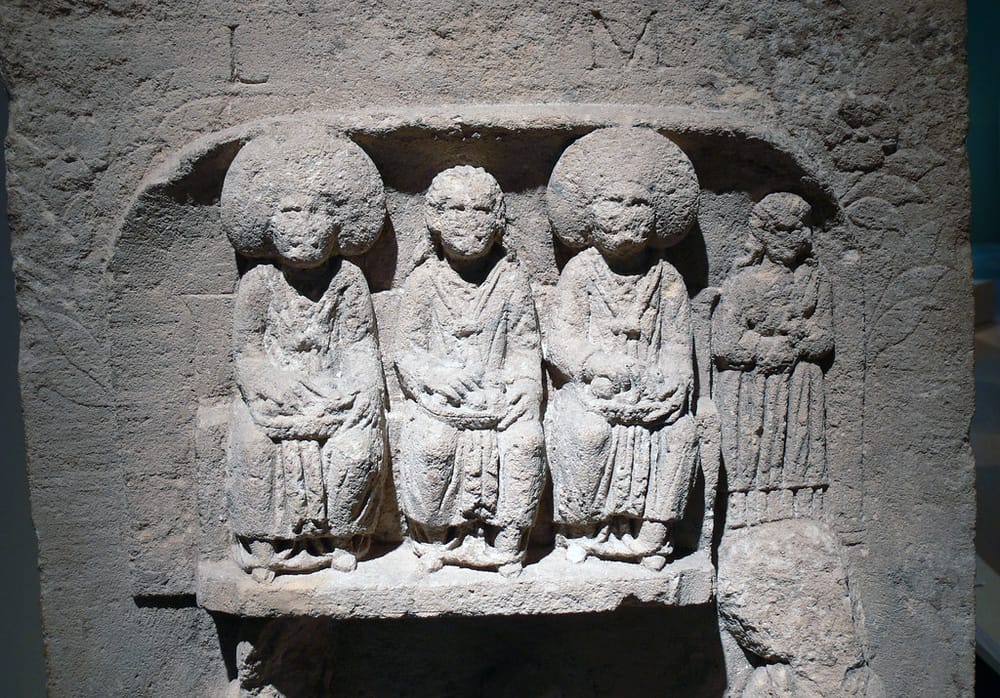
In what is now Rhein-Erft-Kreis, inscriptions were found dedicated to the matronae Austriahenae—mother figures, plural, local, rooted. Not a single, unified deity, but a constellation.
Linguists tracing these names back through the Germanic tongues into Proto-Indo-European find sketches of a much older figure there: a dawn goddess, *H₂ewsṓs. A being of first light. Of arrival. Of the moment when darkness loosens its hold but hasn’t yet disappeared.
From that horizon, names like Ēostre and Ostara begin to make a different kind of sense, like impressions left in wet earth.
For a long time, people argued that Bede might have imagined her. That this goddess was a scholarly ghost. But with new finds, and the slow unfolding of linguistic study, most now accept that something—someone—was there.
A Being of First Light.
Ostara is a dawn figure. A gathering point. A meeting place in the sky.
To speak her name / to recognize a sacred pause in their honour / to pause and breathe in the balance is to participate in a larger gesture: holding space for what was dismissed, diminished, disapeared.
To mark the Equinox as a Witch is part of a quiet, ongoing refusal to let sacred stories disappear.
The Spiritual Meaning of the Spring Equinox
On this day, shadows don’t disappear.
They stand with us.
We’re invited to see what’s been moving underneath:
quiet griefs, inherited patterns.
And also:
the ideas beginning to spark, the sprouts and seedlings,
the small recalibrations,
the openings we almost miss.
Light emerges from dark; the gentle dark follows the bright blaze. Nothing—no system, no identity, no suffering—lasts forever.
Astrology of the Equinox: Crossing into Fire
Astrologically, the Spring Equinox coincides with the Sun’s entrance into Aries, the first sign of the zodiac. This is the beginning of the astrological year—a spark.
Aries is cardinal fire: initiating, restless, alive with impulse. If Pisces season dissolves, Aries ignites.
Around this time, the sky holds a tension between endings and beginnings:
- Planets lingering in Pisces ask for surrender, grief work, release
- Aries placements push toward action, risk, emergence
It can feel contradictory because it is. The equinox doesn’t resolve that tension—it sanctifies it.
You might notice:
- sudden clarity after a long fog
- impatience with what no longer fits
- a desire to begin before you feel fully ready
That’s the season speaking.
Rebirth, Power, and the Stories Beneath the Surface
This season carries stories. Not simple ones. Not clean ones. In the Ostara Chapter of our book, "Missing Witches: Recovering True Histories of Feminist Magic" Risa writes,
Eostar is the promise of change and revelation. The promise that the world will turn. That light will come out of the dark; and the gentle dark will follow the blinding. We will use the stones that have been thrown against us to build new homes. If you have been hunted or slandered for your healing and your magic and your knowledge, then you are a part of the history that the world has been missing.
For all those who have been persecuted under the rubric witch, or dismissed and fetishized with “witch doctor,” we want to own that name. Burnish it by the light of our own fires and claim its power.
We tell two versions of the story of how colonization has used witches, and how witches have survived and planted themselves like seeds to change the future:
We trace the life of Paula de Eguiluz—born into slavery, moved across oceans, sold away from her mother, who became a healer in Cartagena de Indias. A curandera working within dense crossings of African, Indigenous, and Iberian knowledge, under the sanctioned violence of the Inquisition. Accused, tried, punished—again and again—she learned to move within that system with precision. She shaped language. Influenced outcomes. Survived. Bishops paid for her work. Powerful men relied on her. In the dark, she flourished. Her roots spread sideways, rhizomatic, impossible to fully contain.
And we listen to María Sabina, who carried the visionary language of psilocybin mushrooms from the mountains of Oaxaca into the global imagination. She opened ceremonies to outsiders. The world rushed in—curious, extractive, hungry. Her life changed under that pressure. And still, her words remain. Her practice continues to shape how so many encounter healing, language, the sacred.
These are stories of survival. Contradiction. Power under pressure.
Feel the balance sway in your body and don't force a resolution:
gratitude and fury,
healing and harm,
light and shadow.
What Ostara Asks of Us
We aren’t outside these histories.
We’re living in their continuation.
This season asks us to notice patterns:
how power reaches for what it desires and then punishes it,
how knowledge is sought and then suppressed,
how division is cultivated where kinship could grow.
And it asks us to be changed by what we see.
To be unsettled.
Ostara Rituals: Grounded Practices for the Equinox
Make a new altar
Clean a surface.
Choose personal symbols of light and dark.
what's been hard,
what's growing anyway.
Work with dreams
Write them down. Fragments are enough.
There’s a different fertility here—the subconscious kind.
Let it speak in its own language.
Honour ancestors of resistance
Add someone who embodies endurance, not perfection.
Offer attention. A candle. A song.
Plant something
Seeds. Words.
Tend to them. Notice what changes.
Invocation for Ostara
"I open the book" said Maria Sabina,
I talk to the stars
I am dangerous and divine
I am gratitude and fury
I am rooted in the common ground
"I shepherd the immense" said Maria Sabina,
Witches alive, and those returned to the fabric of it all—on Ostara we raise our knowledge of the dark like a cup, and gather our power.
We remember:
what has been buried is still alive.
seeds break open in darkness.
change isn’t given—it’s grown.
We allow ourselves to feel the balance in our bodyminds, to feel the coming light. To shepherd the immense.